
By Rob Moal, Online Personal Trainer | FMS, CAFS, Precision Nutrition | Published: 2026
Quick Answer
The best fat loss workouts for people over 35 are built around compound resistance training — not HIIT, not spin classes, not long cardio sessions. Progressive strength training preserves and builds muscle tissue, which drives metabolic rate and produces lasting body composition changes. Cardio supports fat loss but cannot replace resistance training as the foundation. For people over 35 specifically, the hormonal environment makes muscle preservation the most critical variable in any fat loss program.
Walk into most group fitness studios, and you will find high-intensity cardio, metabolic circuits, and programming designed to make you sweat. These workouts have a market because they feel effective. They are not the most effective tools for fat loss after 35.
After 35, the hormonal environment changes. Muscle mass starts declining. The body becomes less efficient at preserving lean tissue during a calorie deficit. The workouts that produce lasting fat loss in this age group are the ones that address muscle preservation directly, not the ones that produce the most sweat.

Squats, deadlifts, Romanian deadlifts, hip thrusts, rows, presses, and carries. These movements recruit the most muscle mass, produce the greatest metabolic demand during and after the session, and drive the hormonal adaptations that support fat loss. They also directly address the muscle loss that accelerates after 35.
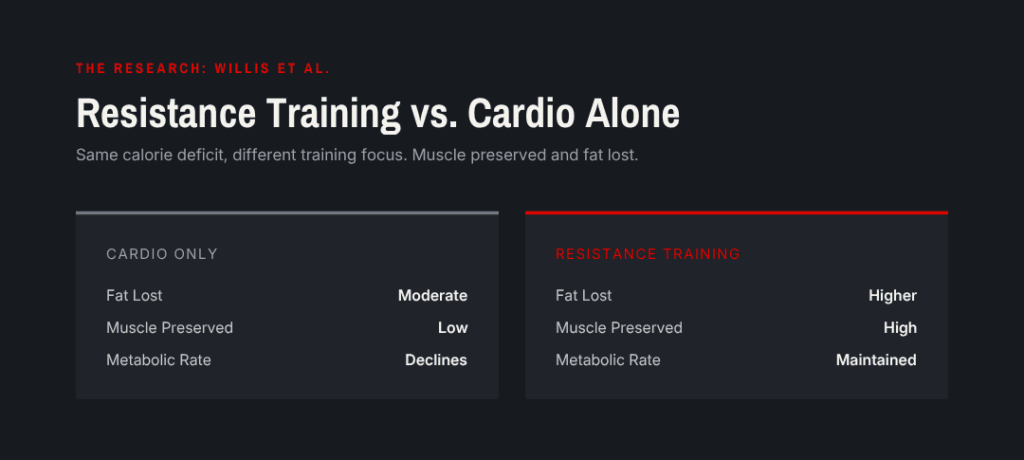
Research published in the Journal of Applied Physiology by Willis et al. confirms that resistance training with a moderate calorie deficit produces superior body composition outcomes compared to cardio alone: more fat lost, more muscle preserved. That finding has been replicated consistently across multiple populations. The approach to fat loss training I use with clients is built around this evidence, not around what feels hard in the moment.

For most people over 35 training three to four days per week, an upper/lower split works well. Two upper body sessions and two lower body sessions per week allow each muscle group adequate training stimulus while providing 48 to 72 hours of recovery. A sample week:

Cardio is not the enemy. It is a supporting tool. Two to three moderate-intensity sessions per week on top of resistance training contribute meaningfully to the overall calorie deficit without the recovery cost of additional resistance sessions. The mistake is making cardio the primary tool and resistance training the afterthought.
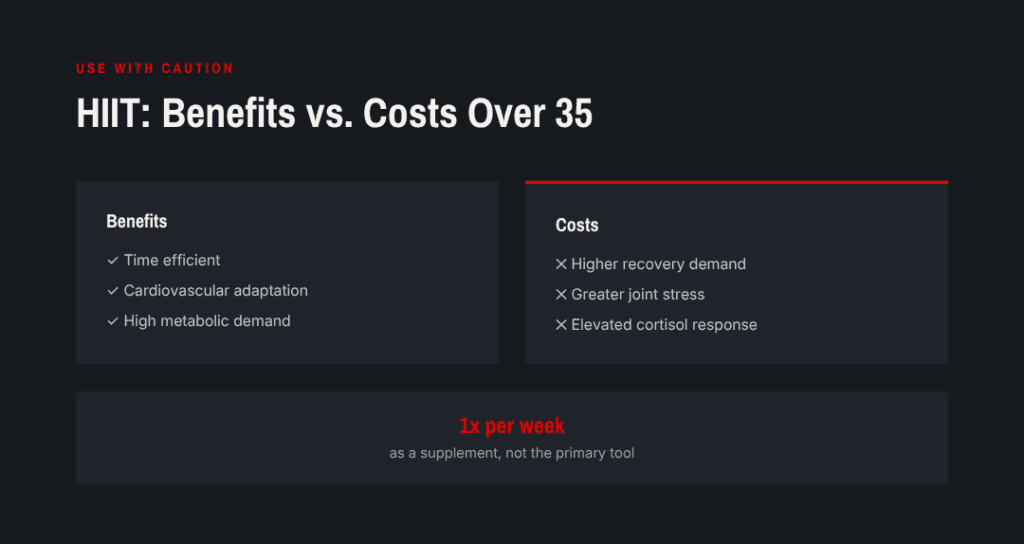
High-intensity interval training has real benefits: time efficiency, cardiovascular adaptation, and metabolic demand. It also has real costs for this age group: higher recovery requirement, greater joint stress, and elevated cortisol response. A 2011 review in the Journal of Obesity by Boutcher found that while HIIT produces meaningful fat-loss effects, its recovery demands make it a poor primary tool for adults managing significant training loads. One HIIT session per week as a replacement for a moderate cardio session is a reasonable inclusion. Making it the cornerstone of the program is not.
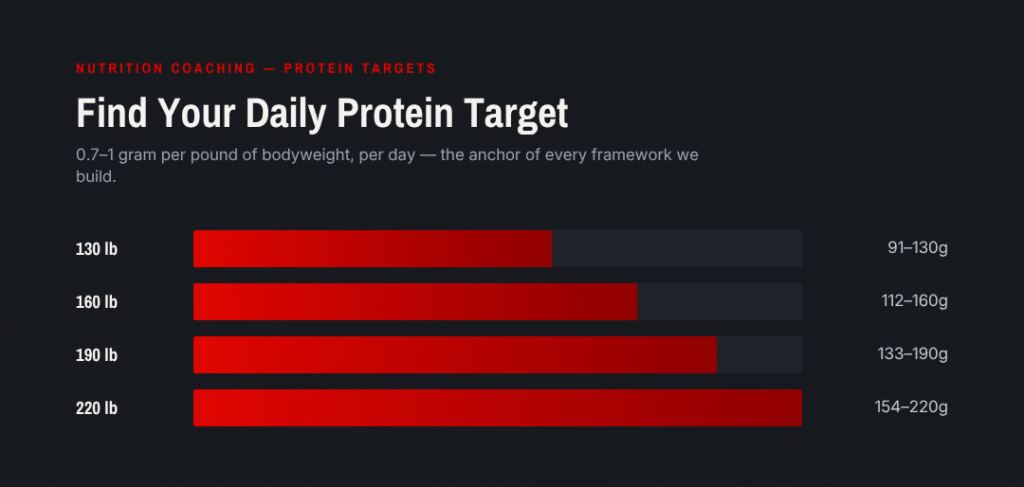
No workout program outworks a poor diet. For fat loss after 35, protein is the highest-leverage variable. Getting to 0.7 to 1 gram of protein per pound of bodyweight per day, in a moderate calorie deficit, preserves the muscle tissue that resistance training builds. Women over 35 and men in this age group both benefit significantly from integrating nutrition alongside training rather than treating them as separate conversations.
Key Takeaways
Compound resistance training — squats, deadlifts, rows, and presses — is the most effective exercise category for fat loss after 35. These movements build and preserve muscle, drive metabolic rate, and produce body composition changes that cardio alone cannot replicate.
HIIT is effective but has a significant recovery cost for people over 35. One session per week alongside regular resistance training is reasonable. Making it the primary fat loss tool is not optimal for this age group.
Three to four resistance training sessions per week, with two to three moderate-intensity cardio sessions, is a practical and evidence-supported approach.
Yes, as a supporting tool. Cardio contributes to the overall calorie deficit and has real cardiovascular health benefits. For fat loss that lasts, resistance training needs to be the foundation.
The most common reasons are insufficient resistance training relative to cardio, inadequate protein intake, poor sleep elevating cortisol and hunger hormones, or training volume that exceeds recovery capacity.
Rob Moal
Rob Moal is an online personal trainer with over 20 years of experience training busy professionals, executives, and athletes. He holds credentials in FMS, CAFS (Grey Institute), and Precision Nutrition, and has been featured in GQ, Forbes, Men’s Journal, Parade, and Eat This Not That.
Book a Free Intro Call