
Author: Rob Moal, Online Personal Trainer | Published: 2026 | Reviewed by: Rob Moal, FMS, CAFS, Precision Nutrition
Quick Answer
Fat loss for women over 35 works differently than it did in your 20s — not because the fundamentals change, but because the hormonal environment does. Declining estrogen, reduced muscle mass, and slower recovery all affect how the body responds to training and nutrition. The approach that actually works combines progressive resistance training, adequate protein, and a moderate calorie deficit — in that order of priority.
The most frustrating thing I hear from women in their mid-30s is that they are doing everything they used to do and nothing is changing. Same workouts. Same diet. Different results.
This is not a willpower problem. It is a biology problem. And it has a solution, but it requires understanding what has actually changed and adjusting accordingly.

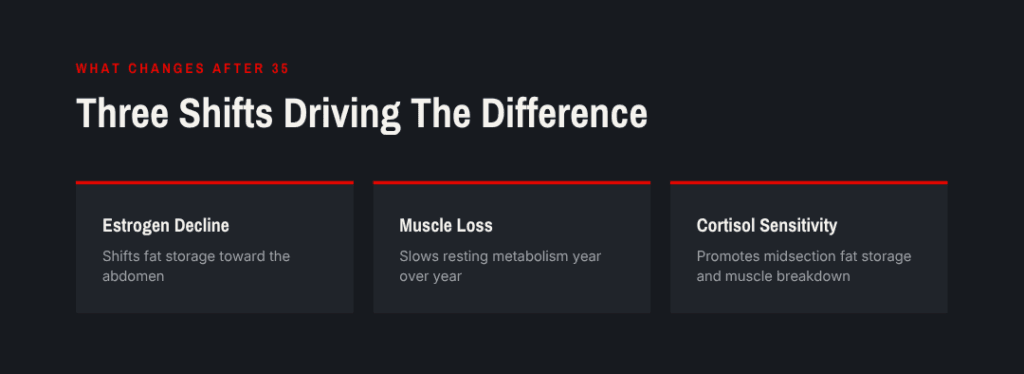
Estrogen plays a role in regulating where the body stores fat. As it declines through the mid-30s and into perimenopause, fat distribution shifts toward the abdomen. Research published in the International Journal of Obesity confirms that visceral fat accumulation accelerates significantly during this hormonal transition, and that this process responds to resistance training more effectively than to cardio or calorie restriction alone.
Sarcopenia begins in the mid-30s and accelerates without resistance training. Muscle is metabolically active tissue. The less of it you have, the fewer calories you burn at rest. A 2010 study in Medicine and Science in Sports and Exercise found that resistance training is the most effective tool for preserving and rebuilding muscle mass during this hormonal transition, more effective than cardio, calorie restriction, or any combination of the two without lifting.
Cortisol Sensitivity Increases
Chronic stress and poor sleep raise cortisol. After 35, the body becomes more sensitive to elevated cortisol, which promotes fat storage, particularly midsection fat, and actively breaks down muscle tissue. Managing stress and prioritizing sleep are part of the fat loss protocol, not suggestions.
This is not negotiable. Fat loss personal training done correctly is built around compound resistance training three to four times per week, not endless cardio. Progressive compound movements drive the metabolic and hormonal adaptations that make fat loss stick after 35.
Most women trying to lose fat are under-eating protein. A target of 0.7 to 1 gram of protein per pound of bodyweight per day supports muscle preservation during a calorie deficit, keeps hunger lower, and improves body composition outcomes compared to lower protein approaches. Nutrition coaching that addresses protein as the primary variable produces significantly better results than generic calorie calculators or elimination diets.
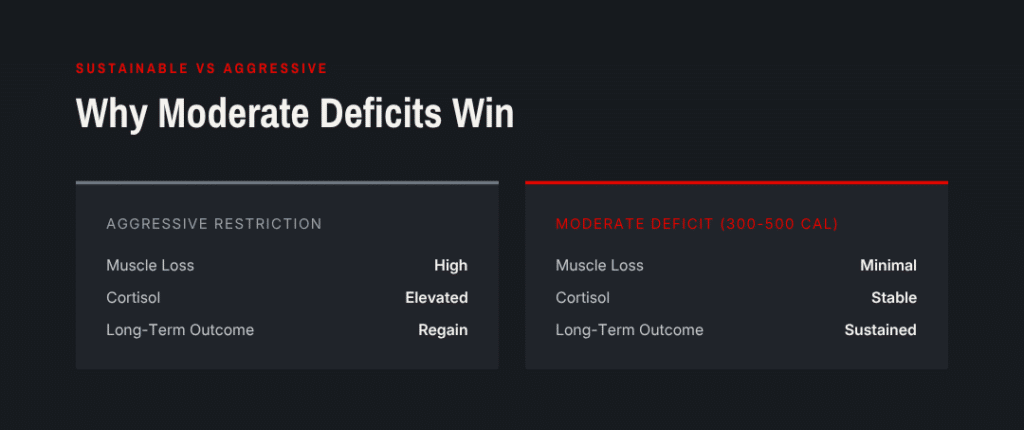
Fat loss requires a calorie deficit. What changes after 35 is how aggressive that deficit should be. Extreme restriction elevates cortisol, accelerates muscle loss, and makes the metabolic slowdown worse. A moderate deficit, roughly 300 to 500 calories below maintenance, combined with high protein and resistance training, produces better outcomes than aggressive restriction.
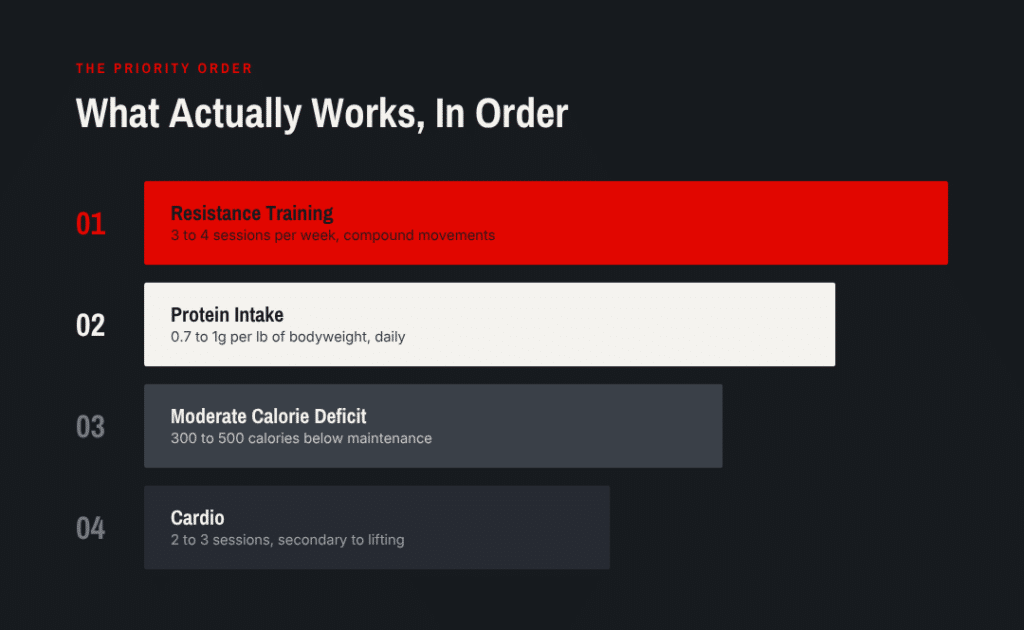
Excessive cardio in a calorie deficit without adequate resistance training accelerates muscle loss, the exact opposite of what the metabolism needs after 35. The women who get lasting results are the ones who prioritize strength training over running.
Eating very little produces short-term weight loss. It almost always results in muscle loss alongside fat loss, a further metabolic slowdown, and weight regain when normal eating resumes. This is the cycle most women have been through multiple times. Breaking it requires a different approach, not more restriction.
Declining estrogen, age-related muscle loss, and increased cortisol sensitivity all affect how the body stores and burns fat after 35. The fundamentals have not changed — calorie deficit, protein, resistance training — but the hormonal environment means the same approach that worked at 25 is less effective at 37 without adjustments.
The consistent factors in successful fat loss after 35 are adequate protein (0.7 to 1g per pound of bodyweight), a moderate calorie deficit, and an eating pattern sustainable enough to maintain for months. Aggressive restriction and elimination diets tend to accelerate muscle loss and worsen metabolic rate.
Two to three moderate cardio sessions per week alongside three to four resistance training sessions is a balanced approach. More cardio at the expense of resistance training is counterproductive for body composition after 35.
Yes — more effectively than cardio alone. Resistance training builds and preserves muscle, which increases resting metabolic rate and drives body composition changes the scale does not fully capture.
With consistent training and nutrition, most women notice meaningful changes within 6 to 8 weeks. Significant transformation takes 3 to 6 months.
Key Takeaways
REFERENCES
Rob Moal
Rob Moal is an online personal trainer with over 20 years of experience training busy professionals, executives, and athletes. He holds credentials in FMS, CAFS (Grey Institute), and Precision Nutrition, and has been featured in GQ, Forbes, Men’s Journal, Parade, and Eat This Not That.
Book a Free Intro Call