
Author: Rob Moal, Online Personal Trainer | Published: 2026 | Reviewed by: Rob Moal, FMS, CAFS, Precision Nutrition
Quick Answer
The best strength training approach for women over 35 is built around compound movements, progressive overload, and adequate protein — not light weights, high reps, and endless cardio. After 35, hormonal shifts accelerate muscle loss and change how the body stores fat. Resistance training is the most effective tool for reversing both. The goal is not to get bulky. It is to build the lean, functional body that cardio alone cannot produce.
Why Strength Training Hits Different After 35
Most women I work with come to me having done the same thing for years. Cardio, classes, maybe some light dumbbell work. They are not lazy. They are not undisciplined. They have just been given the wrong tools for what their body actually needs at this stage.
After 35, estrogen starts to decline. Muscle mass begins to drop. The metabolism slows. Fat distribution shifts, particularly around the midsection. These changes respond to one thing better than anything else: progressive resistance training.
Personal training for women in Vancouver built around these realities produces different results than a generic group fitness program, because it addresses what is actually happening hormonally, not just what makes someone sweat.
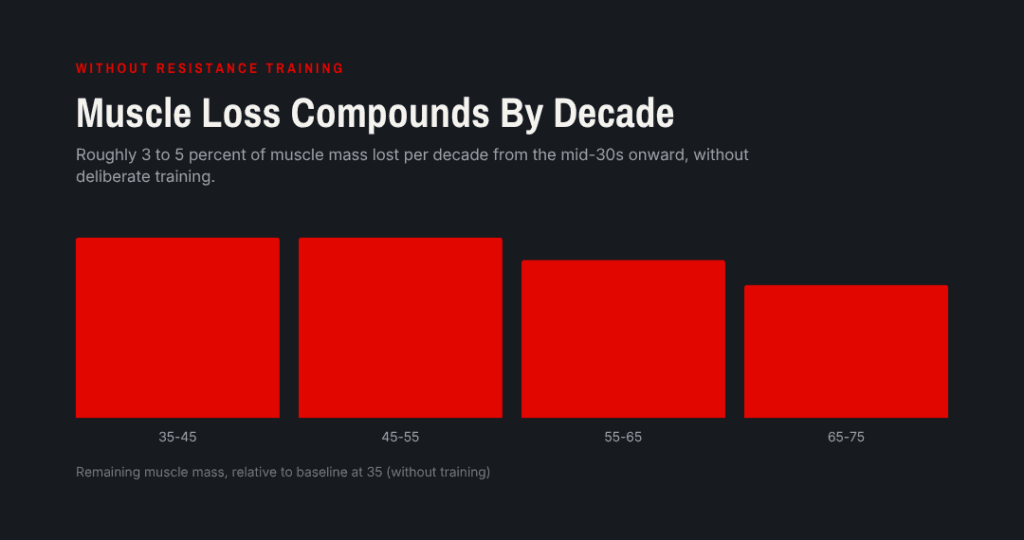
Estrogen and muscle mass are connected. As estrogen declines, the body becomes less efficient at building and retaining muscle. Without deliberate resistance training, women lose roughly 3 to 5 percent of muscle mass per decade from their mid-30s onward. That loss drives the metabolic slowdown most women notice and attribute to age alone.
Bone density also starts declining in the mid-30s. The National Osteoporosis Foundation identifies weight-bearing and resistance exercises as among the most effective strategies for building and maintaining bone mass, which makes strength training a long-term health investment, not just a body composition tool.
Squats, deadlifts, hip hinges, rows, and presses. These movements recruit the most muscle mass, produce the greatest metabolic demand, and build the functional strength that carries into everything else. They are also the movements most women have been told to avoid or have never been taught properly.
Working with a strength training coach in Vancouver who understands female physiology after 35 establishes the movement patterns that make loading these exercises safe and productive from the start, which is the difference between progress and injury in the first few months.
The body adapts to what you consistently demand of it. If the weight never changes, the stimulus never changes, and neither does the body. Progressive overload, adding weight, reps, or volume over time, is the mechanism that drives continued adaptation.
Most women have been trained to stay in a comfortable range. That comfort is exactly why progress stalls. The load needs to be challenging. Not reckless. Challenging.

Three to four sessions per week is the optimal range for most women over 35. A 2009 position statement from the American College of Sports Medicine confirms that this frequency provides sufficient stimulus for meaningful strength adaptation while allowing adequate recovery. Two sessions per week produce results, just more slowly.

This comes up in almost every first conversation. Women have significantly lower testosterone levels than men; testosterone is the primary hormonal driver of muscle hypertrophy. Without it in significant quantities, building large amounts of muscle mass is physiologically very difficult.
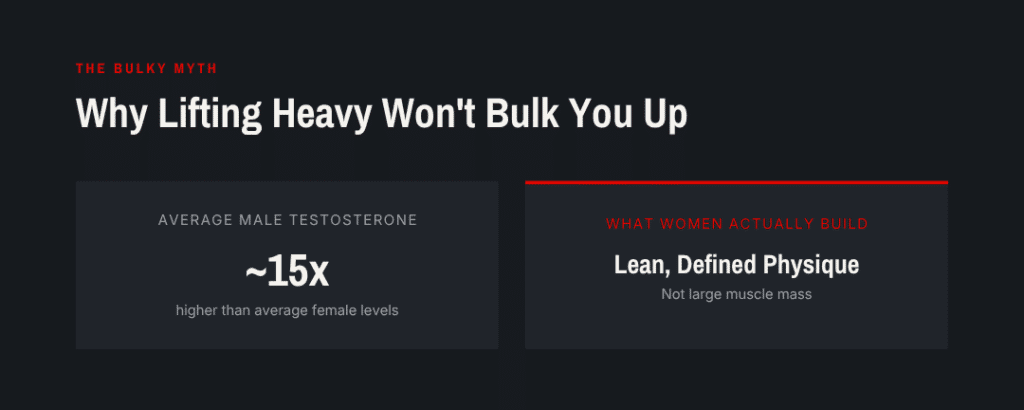
What progressive strength training actually produces in most women is a leaner, more defined physique with better posture and significantly improved body composition. A 2012 review in Current Sports Medicine Reports found resistance training to be one of the most effective interventions for improving body composition in women across age groups. The research on this is consistent.
Muscle adaptation requires raw material. For women over 35, the research supports a protein target of 0.7 to 1 gram per pound of bodyweight per day. Most women are significantly under this, particularly those who have been focused on calorie restriction. For a structured approach to getting nutrition right alongside training, nutrition coaching in Vancouver addresses both sides of the equation together.
Sleep is where adaptation happens. Seven to nine hours is not a luxury. It is when muscle protein synthesis peaks, cortisol normalizes, and the neural adaptations from training consolidate. Chronic poor sleep undermines everything else in the program. This matters more after 35 than at 25.
Only doing cardio. Cardiovascular training has real health benefits. It does not address muscle loss, bone density, or the metabolic rate changes that happen after 35. For fat loss that lasts, resistance training needs to be the foundation. Cardio supports it; it does not replace it.
Training without progression. Doing the same workout with the same weights week after week produces maintenance, not change. The program needs to evolve as you do.
Avoiding compound movements. The exercises that feel intimidating are usually the ones that produce the most change. Learning them correctly is worth the investment.
Key Takeaways
Yes. Progressive resistance training with challenging loads is one of the most effective things women over 35 can do for body composition, bone density, and metabolic health. The concern about getting bulky is not supported by physiology — women do not have the hormonal profile to build large amounts of muscle mass without extreme effort and specific conditions.
Three to four sessions per week is the sweet spot for most women over 35. This provides enough stimulus for consistent adaptation while allowing adequate recovery. Two sessions per week produce results, just more slowly.
Compound movements — squats, deadlifts, hip hinges, rows, and presses — are the foundation. These recruit the most muscle mass and produce the greatest metabolic demand. They also build the functional strength that carries into daily life and reduces injury risk.
Yes, and more effectively than cardio alone. Resistance training builds muscle, which increases resting metabolic rate. It also produces the body composition changes — more lean mass, less fat — that the scale alone does not capture. For lasting fat loss after 35, strength training needs to be the foundation of the program.
The research supports 0.7 to 1 gram of protein per pound of bodyweight per day for women engaged in resistance training. Most women are significantly under this target, particularly those focused on calorie restriction rather than body composition.
REFERENCES
Rob Moal
Rob Moal is an online personal trainer with over 20 years of experience training busy professionals, executives, and athletes. He holds credentials in FMS, CAFS (Grey Institute), and Precision Nutrition, and has been featured as a fitness expert in GQ, Forbes, Men’s Journal, Parade, and Eat This Not That.
Book a Free Intro Call