
By Rob Moal, Online Personal Trainer | FMS, CAFS, Precision Nutrition | Published: 2026
I’ve had more conversations about Ozempic in the last year than in the previous twenty combined. Most of them start the same way. Someone’s losing weight fast, feeling great about the number on the scale, and then six months in they notice they’re weaker. Stairs feel harder. Grocery bags feel heavier. That’s not in your head. That’s muscle.
Here’s what nobody tells you when you get the prescription: the drug doesn’t know the difference between fat and muscle. It just creates a calorie deficit, and your body decides what to burn. Without a plan, it burns some of both.
The range in the research is wide, and that’s not researchers disagreeing; it’s real variation between people and drugs. A narrative review on lean body mass changes found reductions ranging from as little as 15% to as much as 60% of total weight lost, depending on the study. Semaglutide trials tend to land higher than tirzepatide trials, somewhere around 25% to 39% of total weight loss coming from lean mass.
For context, that’s not wildly different from any aggressive diet. Surgical weight loss studies show a similarly wide range, so this isn’t unique to GLP-1s. It’s what happens any time you lose weight fast without doing anything to protect the muscle.
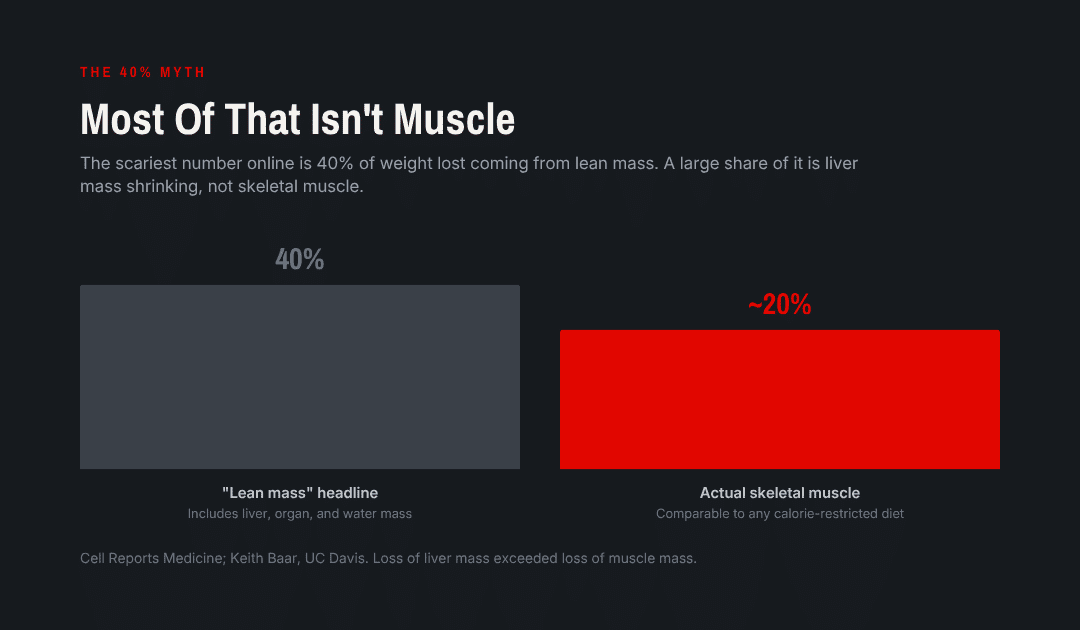
Here’s the part that actually changed how I explain this to clients. A study published in Cell Reports Medicine looked at both mice and humans and found that GLP-1 drugs predominantly reduce fat, with only a small decrease in lean mass, and that loss of liver mass actually exceeds the loss of muscle mass. UC Davis exercise physiologist Keith Baar put it plainly: you’re losing around 20% muscle mass, which isn’t much different from a calorie-restricted diet, and a lot of the reported 40% lean mass number is actually coming from the liver shrinking, not your muscles.
That matters because the scariest number floating around online (40%) is mostly not muscle at all.
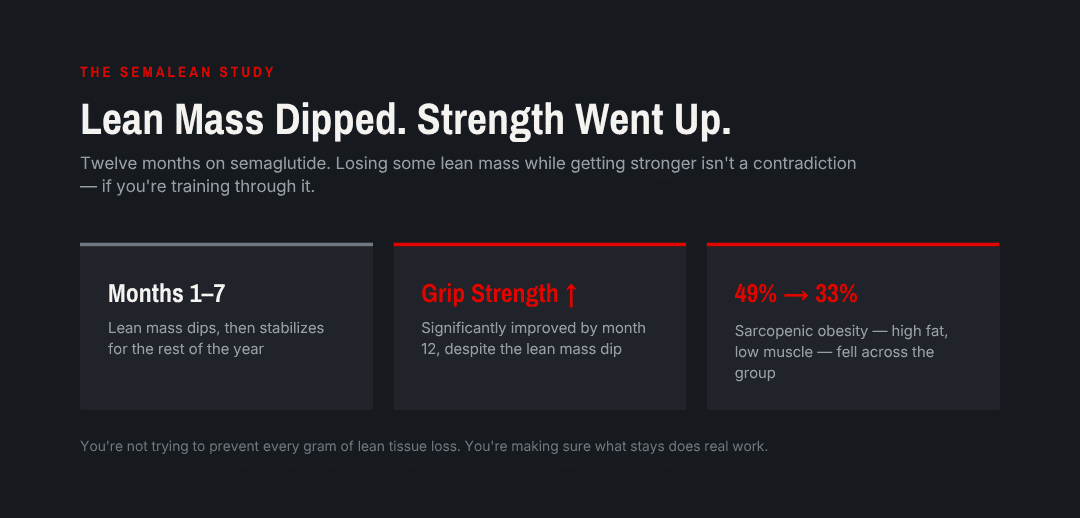
This is the part I didn’t expect going into the research, and it’s worth sitting with. The SEMALEAN study tracked people on semaglutide for a full year and found lean mass dipped in the first seven months, then stabilized. Handgrip strength actually improved significantly by month 12. Sarcopenic obesity, having both excess fat and low muscle, dropped from 49% of the study group to 33%.
Translation: losing some muscle mass while getting stronger isn’t a contradiction. If you’re training through it, your relative strength and function can improve even as the number on the scale for lean mass ticks down. That’s the whole game. You’re not trying to prevent every gram of lean tissue loss. You’re trying to make sure what stays is doing real work.
If you’re a woman in perimenopause or postmenopause starting a GLP-1, you’re dealing with two things stacking on top of each other, not one.
Estrogen is anabolic. It helps maintain muscle. As it declines through menopause, you’re already losing muscle mass faster than you were in your 30s and 40s, a process called sarcopenia. That’s happening whether or not you’re on a GLP-1. Add appetite suppression and a calorie deficit on top of that, and you’re compounding two separate mechanisms of muscle loss at the same time.
Estrogen also affects where you store fat. As it drops, fat storage shifts from hips and thighs to the abdomen, and that visceral fat is metabolically active in a way that’s worse for you than subcutaneous fat. It drives inflammation and insulin resistance.
There’s also encouraging research on combining approaches. A study published in Menopause found that postmenopausal women on both semaglutide and hormone therapy lost significantly more weight than semaglutide alone, at every checkpoint measured across a year. Hormone therapy isn’t something I prescribe, obviously; that’s a conversation for your doctor. But it’s worth having if you’re in this window and considering a GLP-1.
Bone density deserves a mention here too. Postmenopausal women already face accelerated bone loss from declining estrogen, and rapid weight loss can compound that. The protective strategy is the same one that protects muscle: enough protein and consistent resistance training. If you have a personal or family history of osteoporosis, get a baseline DEXA scan before starting an aggressive weight loss protocol.
If this is you, my menopause training guide walks through how to structure training around these hormone shifts specifically, and you can run your numbers through the menopause training calculator to see where you’re starting from.
Men aren’t off the hook here; they’re just dealing with a different hormone story. Testosterone is the primary driver of skeletal muscle mass, and it declines gradually starting around age 30. Meta-analyses of randomized trials show lean mass losses in men on GLP-1 RAs land in roughly the same range as women, about a quarter to a third of total weight lost.
There’s an interesting wrinkle, though. Excess body fat itself suppresses testosterone through a process called aromatization, where fat tissue converts testosterone into estrogen. Losing that fat can actually help testosterone rebound. One study found obese men using GLP-1 drugs experienced increases in total and free testosterone after fat loss. That’s a genuinely good outcome, but it’s conditional on doing this right. If weight loss happens too fast or protein intake is poor, you lose the muscle before the hormone benefit has a chance to show up.
For men already dealing with clinically low testosterone going into a GLP-1, there’s active research looking at testosterone replacement therapy as a way to preserve lean mass during treatment, since testosterone is one of the key regulators of skeletal muscle. That’s a conversation with your doctor, not something to self-manage, but it’s worth knowing the research exists.
This is where I differ from most of what you’ll read on this topic. Almost everything online tells you to lift weights and eat protein while you’re on the drug. That’s true, but it’s incomplete. There are three distinct phases, and each one needs a different approach.
If you’re even considering a GLP-1, get 4 to 8 weeks of consistent strength training in before your first dose if you can. You’re not trying to get shredded in a month. You’re building a muscle reserve and, just as important, building the habit and the movement competency before your appetite and energy levels change. Starting resistance training within the first week of GLP-1 therapy helps preserve existing muscle as weight loss begins, but starting before that first week is even better. You’re not starting from zero once the deficit hits.
Once you’re on the medication, the target numbers across the research are fairly consistent:
Appetite suppression makes hitting protein targets genuinely hard. This is the number one thing that goes sideways for my clients on GLP-1s. You feel full after four bites, and protein is the first thing to get pushed aside because it takes more effort to eat than it does to skip. If you’re not sure where you land, my protein calculator gives you a target based on your weight and goals so you’re not guessing.
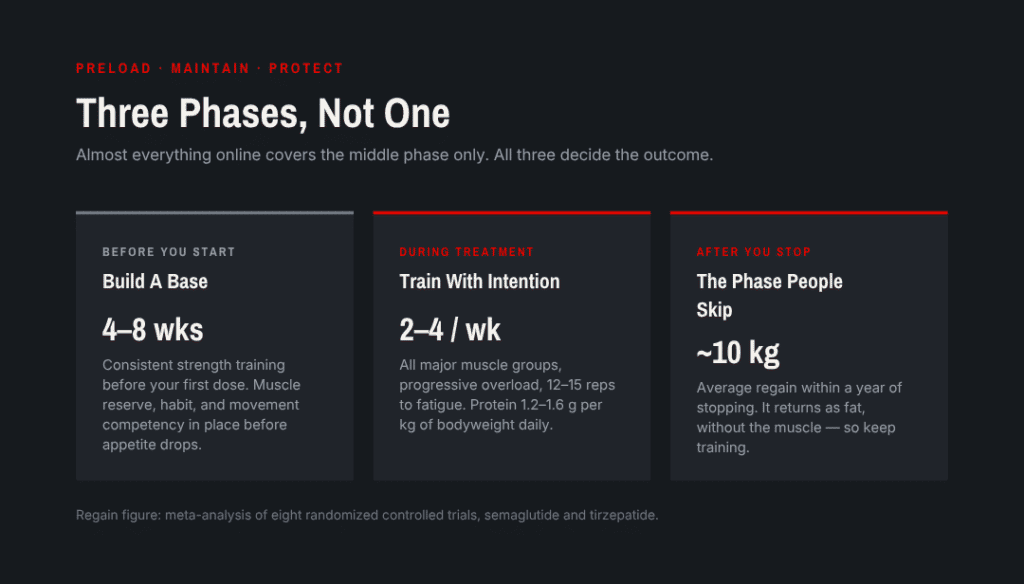
Here’s the piece almost nobody talks about, and it’s the one I think matters most. A meta-analysis of eight randomized controlled trials found that people stopping semaglutide or tirzepatide regained an average of close to 10 kilograms within a year. Worse, weight cycling, losing weight and regaining it, tends to bring back fat mass without a corresponding return of the muscle that was lost. Do that more than once and you’re pushing yourself toward what’s called sarcopenic obesity: high fat, low muscle, which is a much worse metabolic position than where you started.
The training you build during treatment is what determines whether stopping the drug means you keep your results or slide backward. This is the phase where having an actual coach instead of a general plan pays off, because “eat protein and lift” isn’t enough guidance for maintaining a body composition shift over years, not months.
If you’re starting this process and want a plan built around where you’re at, my free GLP-1 training guide covers all three phases in more depth, and you can get a starting estimate from the GLP-1 calculator before we talk. If you want someone building and adjusting the program with you instead of following a static PDF, that’s where strength training coaching comes in.
No. The range across studies is wide, roughly 15% to 40% of total weight lost, and depends on the specific drug, your starting muscle mass, age, protein intake, and whether you’re strength training at all.
Yes. Starting late is still far better than not starting. The ideal is building a base before your first dose, but the second-best time is today.
No. Resistance training doesn’t meaningfully slow fat loss, and it protects the muscle that keeps your metabolism from crashing as the weight comes off.
Research shows significant weight regain after stopping, often within a year, and that regained weight tends to come back as fat rather than muscle if training stops too. Staying consistent with resistance training after you come off the medication is what protects against that.
Cell Reports Medicine. “Weight loss with GLP-1 medicines does not result in a disproportionate loss of muscle mass or function in obese mice and humans.”
UC Davis Health. “UC Davis Health examines systemic impact of GLP-1–based therapies.”