
By Rob Moal, Online Personal Trainer | FMS, CAFS, Precision Nutrition | Published: 2026
Quick Answer
The most evidence-supported strategies for recovering faster between workouts are adequate sleep, sufficient protein intake, light movement on rest days, and managing training volume relative to your recovery capacity. Ice baths, compression gear, and supplements have marginal effects compared to these fundamentals. Most people who feel like they are not recovering well are under-sleeping, under-eating protein, or training more volume than their current fitness level can absorb.
Training is the stimulus. Recovery is where the adaptation occurs. The session breaks tissue down. Sleep, protein, and rest build it back stronger. Skip or shortchange recovery, and you are doing the work without collecting the result.
Most people understand this conceptually and ignore it in practice. They add more sessions when progress stalls, when the actual problem is that recovery cannot keep up with training volume. They chase expensive recovery tools when the fundamentals are not in place. This is one of the most consistent patterns I see across all levels of training experience.
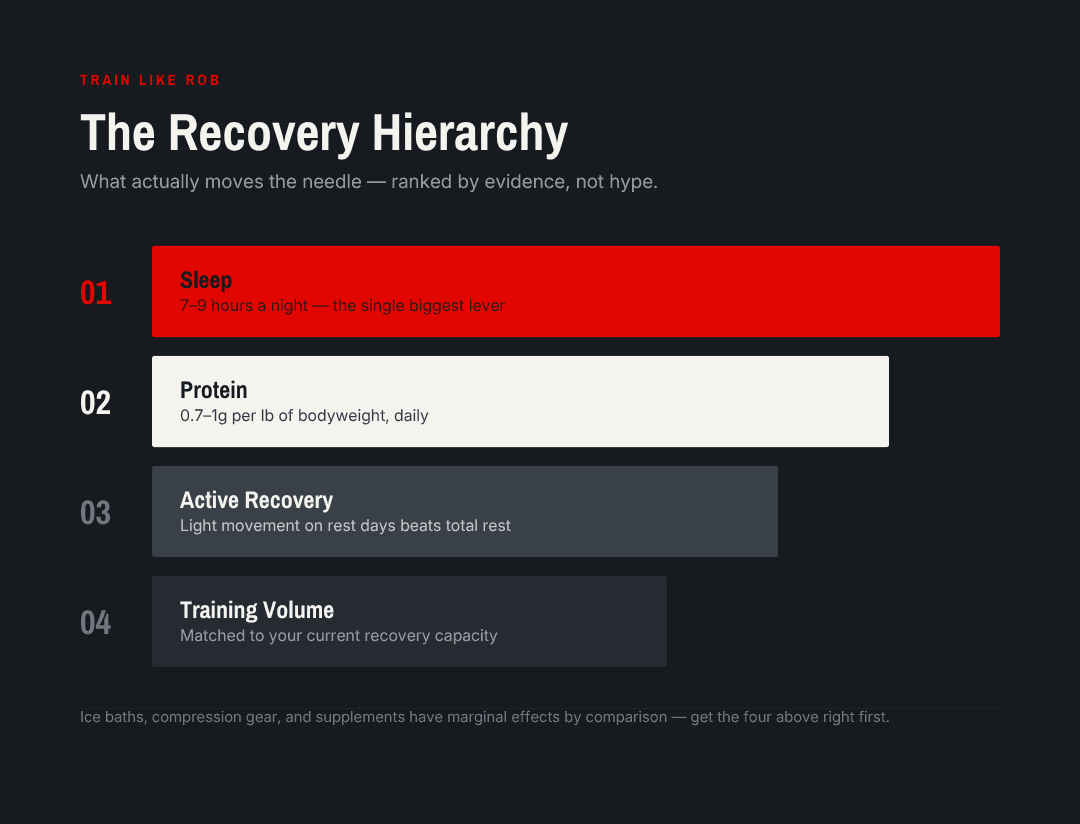
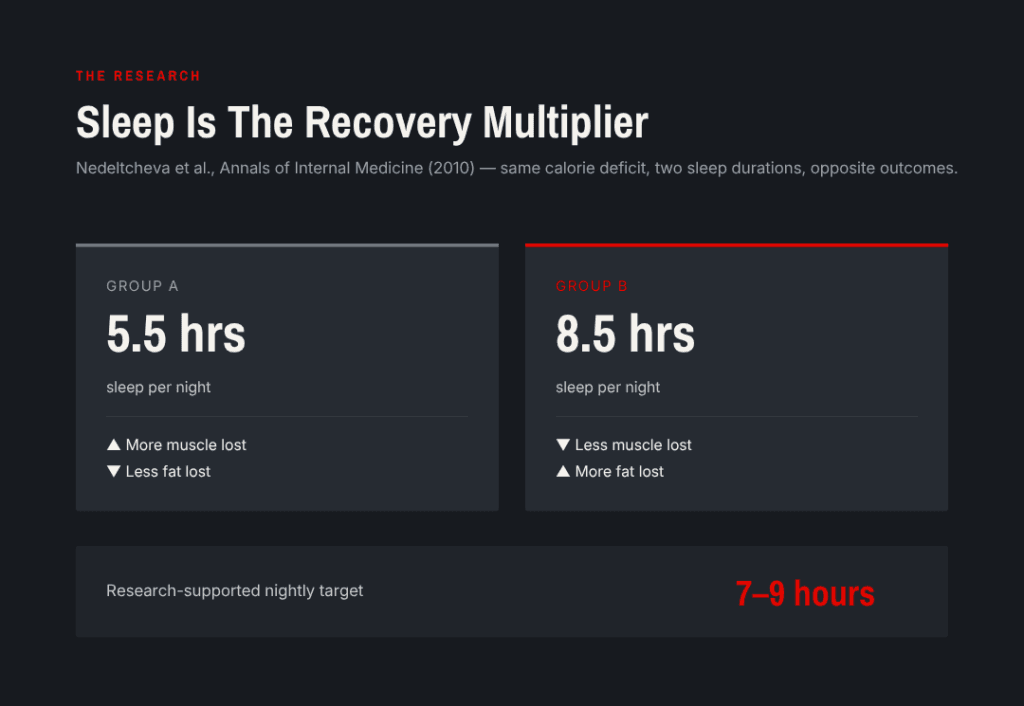
Everything else in recovery is secondary to sleep. Seven to nine hours is the research-supported range. During deep sleep, growth hormone is released, muscle protein synthesis peaks, neural adaptations consolidate, and cortisol normalizes.
A landmark study published in the Annals of Internal Medicine by Nedeltcheva et al. found that people in a calorie deficit who slept 5.5 hours lost significantly more muscle and significantly less fat than those who slept 8.5 hours. Same diet. Different sleep. Completely different outcomes. If your recovery feels off, sleep is the first question.
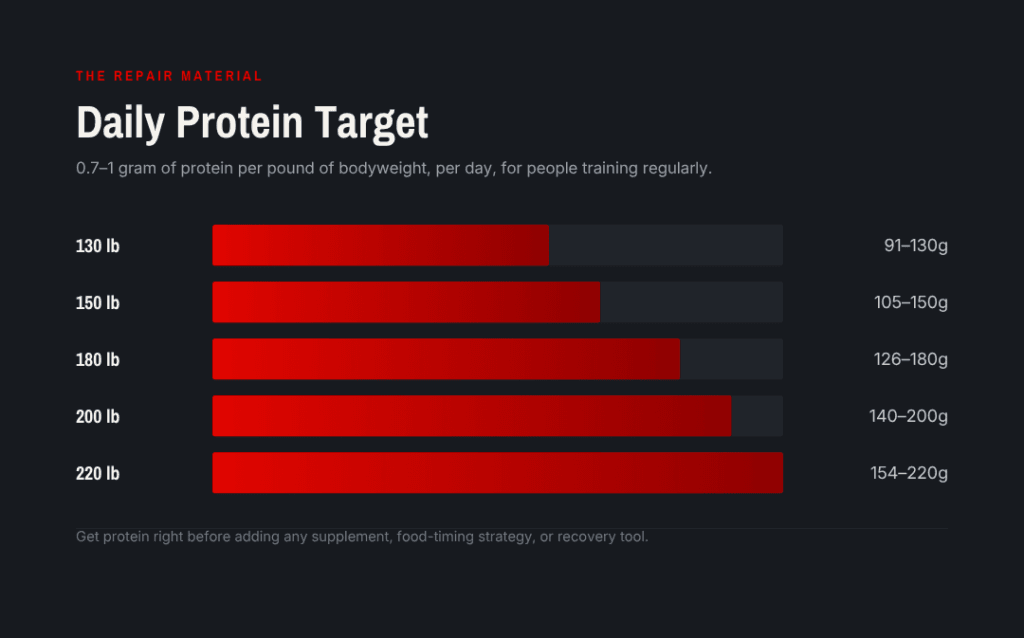
Muscle protein synthesis requires adequate dietary protein. Without enough, you are creating the damage signal without supplying the repair material. The research supports 0.7 to 1 gram of protein per pound of bodyweight per day for people who train regularly. A solid nutritional approach starts here, before any supplement, any specific food timing, or any recovery tool.
Complete rest is not optimal for recovery. Light movement on rest days walking, mobility work, easy cycling, increases blood flow to recovering tissue and reduces muscle soreness. The key distinction is intensity. A 20-minute walk on a rest day supports recovery. A heavy compound session the day after a demanding workout does not.
More volume is not always better. There is a point where adding training stress exceeds the body’s capacity to recover from it. Persistent fatigue, declining performance across consecutive sessions, and soreness that does not resolve between workouts are all signs that volume has exceeded recovery capacity. Reducing volume in that situation is more productive than pushing through.
Cold exposure after training has mixed evidence. A Cochrane Review by Bleakley et al. found modest benefits for acute soreness but noted that the evidence is inconsistent and some research suggests it may blunt adaptation signals for hypertrophy. Get sleep and protein right first.
Creatine monohydrate is one of the most researched performance supplements available. Research by Rawson and Volek confirmed consistent benefits for strength, power output, and cellular energy systems. If you are going to add any supplement, this is the one with the most evidence behind it.
Movement quality affects how efficiently the body absorbs and recovers from training stress. Poor mobility means certain muscles are compensating for others, working harder than they should and recovering more slowly as a result. Mobility and corrective exercise built into a well-structured program is not just injury prevention; it is recovery optimization that compounds over time.
Key Takeaways
Prioritize sleep (7 to 9 hours), adequate protein (0.7 to 1g per pound of bodyweight per day), and light movement on rest days. These three variables have the most evidence behind them — everything else has marginal effects by comparison.
Most muscle groups recover sufficiently within 48 to 72 hours after a training session. Recovery time varies based on training intensity, volume, sleep quality, nutrition, and individual fitness level.
Light active recovery — walking, mobility work, easy cycling — is more beneficial than complete rest. It increases blood flow to recovering tissue and reduces soreness without adding significant training stress.
Yes. Protein is the raw material for muscle protein synthesis. Without adequate protein, the training stimulus exists without the repair capacity. A target of 0.7 to 1 gram per pound of bodyweight per day supports optimal recovery.
Creatine monohydrate has consistent evidence for improving strength, power output, and supporting cellular energy systems involved in recovery. It is one of the few supplements with a meaningful evidence base for resistance training.
Rob Moal
Rob Moal is an online personal trainer with over 20 years of experience training busy professionals, executives, and athletes. He holds credentials in FMS, CAFS (Grey Institute), and Precision Nutrition, and has been featured in GQ, Forbes, Men’s Journal, Parade, and Eat This Not That.
Book a Free Intro Call