
I’ve trained clients outside for years, in bootcamps, one-on-one, and through plenty of wet Vancouver winters. Outside counts as long as there’s effort and a plan. Here’s every option I use around Yaletown, how far the seawall routes actually are, and what kind of results you can expect compared to the gym.

Fat loss and strength don’t care where you train. They come from effort, progression and food. Where location does matter is how the workout feels and whether you keep doing it.
A 2011 systematic review in Environmental Science & Technology pooled 11 trials and 833 adults who walked or ran both indoors and outdoors. Compared with indoor exercise, outdoor exercise was linked to more energy and revitalization, and less tension, anger and depression. People also enjoyed it more and said they were more likely to do it again. The authors were clear that the evidence was limited, but it matches what I see with clients.
Here’s how I split it:
The Vancouver Seawall is 28 km long, the world’s longest uninterrupted waterfront path, and it runs right along Yaletown. Use these routes to plan a walk, run or ride by distance.
| Route | Distance | Miles |
|---|---|---|
| Yaletown Roundhouse to Science World and back | about 4.7 km | about 2.9 mi |
| Stanley Park seawall loop | about 9 km | about 5.6 mi |
| False Creek loop from Yaletown over the Burrard Bridge | about 10.8 km | about 6.7 mi |
| The full seawall | 28 km | about 17.4 mi |
One mile is 1.6 km. If you want a 1- to 2-mile run, go out about 0.8 to 1.6 km from the Roundhouse and turn around.
Walking is the easiest win for weight loss and recovery, because you can do it daily without beating up your joints. Walk fast enough that talking takes a bit of effort, for 30 to 45 minutes. The Science World loop takes most people 45 to 60 minutes at a brisk pace.
False Creek is flat and paved, which makes it one of the best running routes in the city. New to running? Start with run-walk intervals: 1 minute running, 2 minutes walking, 8 rounds. Add a minute of running each week until you can run the Science World loop without stopping.
This is the one I give clients who say they don’t have time. Walk briskly for 10 minutes to warm up, then do 30 seconds hard and 90 seconds easy, 8 to 10 times. Walk back to cool down. It’s done in under 35 minutes.
Cycling is easy on the knees and good for longer cardio days. From Yaletown, the seawall connects to Granville Island, Kits and Stanley Park. Ride for 45 to 60 minutes at a pace where you could still talk in short sentences.
David Lam Park has two public tennis courts right off the seawall. Tennis gives you sprints, lateral movement and rotation, and an hour of running around without noticing. Book it with a friend like you’d book a workout.
There are two basketball courts at David Lam Park and a half court at Coopers’ Park on Marinaside. Shooting around is fine. A real game of pickup is proper conditioning.
Any patch of grass and a bench is a gym. Do four rounds with 60 seconds rest:
When it gets easy, wear a backpack with a few water bottles in it or add a round.
People skip workouts. They don’t skip a friend waiting at the park.
Your dog needs the walk anyway, so make it count. Dogs are allowed on leash on the seawall, and David Lam Park is an on-leash park.
For off-leash play afterwards, Sunset Beach Park has a designated off-leash area. Check the posted rules first.
Kayaking, stand-up paddleboarding and dragon boating all happen on False Creek, right off Yaletown. It’s a solid upper body and core workout that doesn’t feel like training, and a good swap for a summer cardio day.
If you want structure and people around you, join a group. I ran my outdoor bootcamp at David Lam Park, and a lot of my one-on-one clients started there. Indoor classes count too. The Roundhouse Community Centre runs yoga and Pilates through the Park Board, which works well as a recovery day.
These are estimates for a 155 lb person doing 30 minutes. If you weigh more, you’ll burn more, and if you weigh less, you’ll burn less. Walking, running, paddling, yoga and the circuit come from Harvard Health’s calorie chart. Tennis, basketball and cycling are worked out from MET values in the Compendium of Physical Activities.
| Activity (30 minutes) | Calories, 155 lb person |
|---|---|
| Dog walk or easy seawall walk (3.5 mph) | about 133 |
| Brisk seawall walk (4 mph) | about 175 |
| Yoga | about 144 |
| Paddling (kayak) | about 180 |
| Cycling the seawall (10 to 12 mph) | about 210 |
| Seawall run (5 mph, 12-minute mile) | about 288 |
| Seawall run (6 mph, 10-minute mile) | about 360 |
| Tennis, singles | about 280 |
| Pickup basketball, full game | about 280 |
| Bodyweight circuit | about 160 to 300, depending on pace |
Don’t use these numbers to earn food. They’re rough, and fitness trackers usually overestimate. Use them to see which options do more work in the same 30 minutes.
After a workout, aim for a meal with a good hit of protein and some carbs within a couple of hours. For most people, that’s 20 to 40 grams of protein. I break down the numbers on how much protein you actually need.
A few spots close to the seawall:
At any sit-down spot, the formula is the same. Pick a lean protein, add vegetables and a carb, and go easy on the fried sides and the second drink.
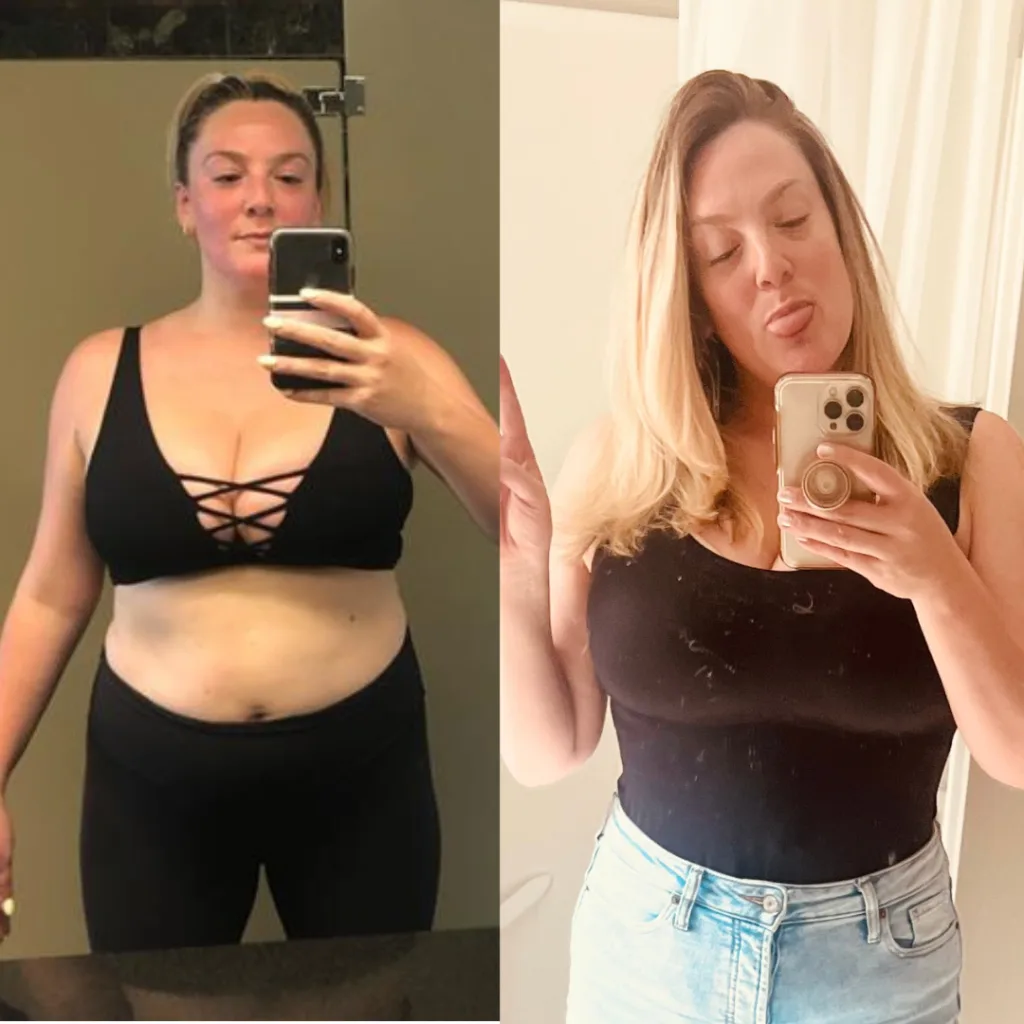
Lindsay joined my outdoor bootcamp at David Lam Park during COVID and went on to train one-on-one with me. She came in during her early 40s, a busy professional chasing weight loss and her first marathon.
Her plan mixed a strength day, a boxing session, and solo runs built around her marathon. We also rebuilt her nutrition after finding a food allergy that was holding her back. She’s a good example of the mix in this post: outdoor work for the running and conditioning, and strength training alongside it.
Keep strength days fixed and move the outdoor days around the weather.
When it pours, swap the outdoor day for an indoor class or your building gym. After 4:30 in winter, stick to the lit parts of the seawall and wear something reflective.
Outdoor training gets you fit, but it doesn’t progress itself. If you want your strength days, outdoor days and food tied together around your schedule, I work with clients as a personal trainer in Yaletown, outdoors, in building gyms and at 658 Homer St.
No. Everything in this post works on its own. A trainer helps when you want a plan that progresses, someone to fix your form, or you keep falling off after a few weeks.
Start with three brisk 30-minute walks a week on the seawall and two short strength sessions. After a month, add run-walk intervals or a bootcamp.
Walking, cycling and paddling are the easiest on your knees. Start there, keep runs short, and skip jumping drills until you’ve checked in with a physio.
Layers you can peel off as you warm up, a light waterproof shell, and shoes with decent grip for wet pavement. Add a hat and gloves on cold mornings, and something reflective after dark.
You might also find these helpful:
Environmental Science & Technology. “Does Participating in Physical Activity in Outdoor Natural Environments Have a Greater Effect on Physical and Mental Wellbeing than Physical Activity Indoors? A Systematic Review.”
Harvard Health Publishing. “Calories burned in 30 minutes for people of three different weights.”
Destination Vancouver. “Dog-Friendly Winter Travel in Vancouver.”
City of Vancouver. “ParkFinder: Basketball Courts.”