
I hear the same thing from almost every woman who walks into my studio in her late 40s or 50s. “I’m doing the same things I always did, and my body isn’t responding the same way.” That’s not in your head, and it’s not just aging in general. It’s menopause specifically, and the research backs up what you’re feeling.
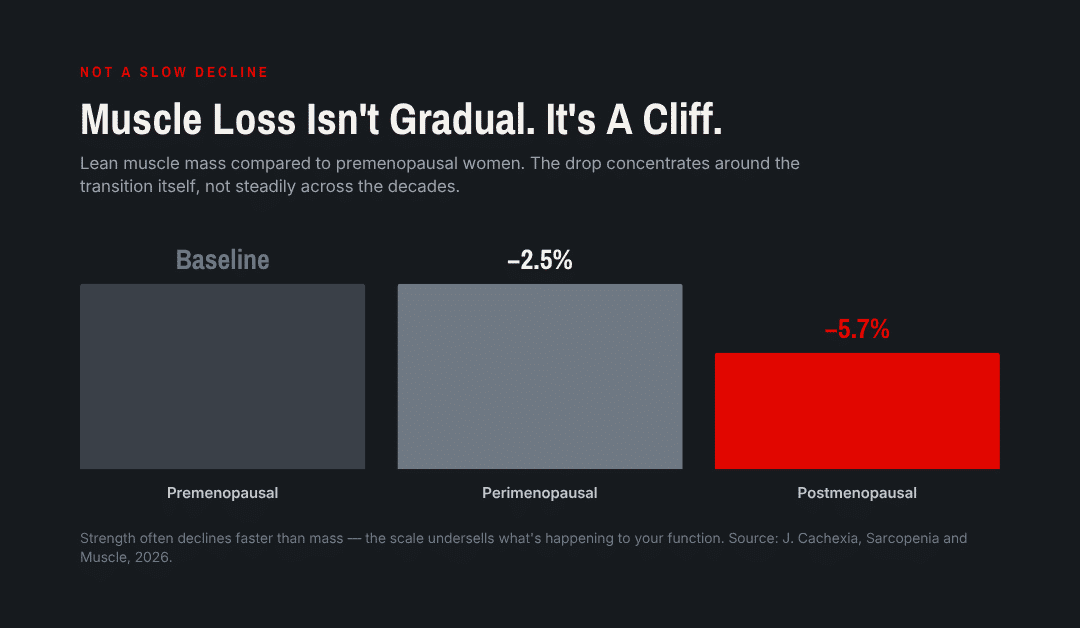
Most people assume muscle loss with age is a slow, steady decline that starts in your 30s and creeps along for decades. That’s true for men, and it’s true for younger women. It’s not what happens at menopause.
Researchers at Deakin University’s Institute for Physical Activity and Nutrition analyzed muscle mass, strength, and gene expression in 100 women aged 18 to 80 alongside their hormone levels. While younger women showed the expected slow decline, middle-aged women showed a much sharper drop that coincided directly with the menopause transition. A companion study found this accelerated decline can start as early as the fourth decade, well before menopause is fully established.
A 2026 review in the Journal of Cachexia, Sarcopenia and Muscle puts numbers on it: lean muscle mass runs roughly 2.5% lower in perimenopausal women and 5.7% lower after menopause, compared to premenopausal women. Strength often declines even faster than mass does, which means the scale and even a body composition scan can undersell what’s actually happening to your function day to day.
Here’s the part that should change how you think about this, not just accept it. A 20-week controlled trial on resistance training with free weights in women aged 40 to 60 found that resistance training effectively counteracts the age and menopause-related loss of muscle mass and strength. The muscle you have still responds to training. Estrogen decline changes the environment your muscle is working in, it doesn’t turn off your ability to adapt.
There’s also research suggesting the story isn’t purely one of decline. Researchers at the University of Guelph studying muscle function through menopause found it isn’t a uniform drop, and at certain stages some muscles can actually get stronger. Menopause changes muscle function in more complicated ways than “everything gets weaker,” which is a more useful and more accurate way to think about training through it than just bracing for loss.
The catch: general strength training guidelines built for younger women tend to undersell what postmenopausal women actually need. Getting real hypertrophy and strength gains at this stage typically requires higher training volumes and intensities than what worked for you at 30. Training lighter because you assume your body can’t handle more is usually the opposite of what the research supports.
Muscle gets most of the attention, but bone is arguably the higher-stakes issue. As estrogen drops, bone density drops with it, and that’s the mechanism behind osteoporosis risk in postmenopausal women. This isn’t a someday problem; it starts accelerating right at the transition.
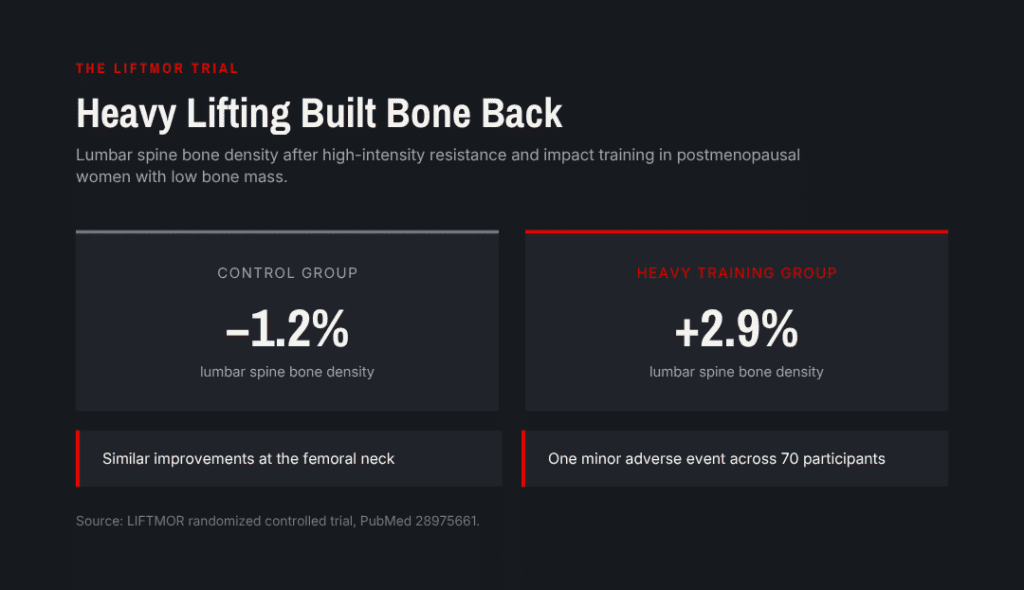
The strongest evidence here comes from the LIFTMOR trial, a randomized controlled trial testing high-intensity resistance and impact training in postmenopausal women with low bone mass. The results were clear: lumbar spine bone density improved 2.9% in the training group versus a 1.2% decline in the control group, with similar improvements at the femoral neck. Compliance was high, and there was only one minor adverse event across 70 participants doing genuinely heavy training. That result mattered because it directly challenged the old assumption that heavy lifting is too risky for women with low bone mass. Done properly and supervised, it’s the opposite.
A separate meta-analysis pooling 75 studies and over 5,000 participants found consistent bone density benefits from exercise training across the lumbar spine, femoral neck, and total hip. This isn’t one study showing a promising result. It’s a well-replicated finding.
This is where I differ from a lot of the generic advice floating around. “Just do some resistance training” isn’t specific enough to move the needle the way the research above describes. A few things matter more than people expect:
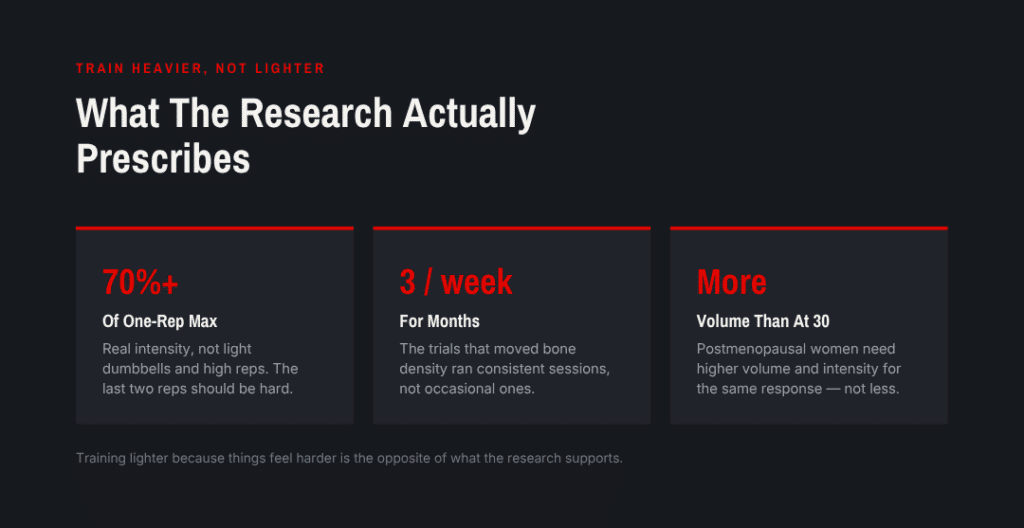
Load matters more than you think. The training protocols that produced real bone and muscle benefits in these studies used real intensity, working around 70% or more of one-rep max, not light dumbbells and high reps. If you’re not challenged by the last two reps of a set, you’re likely not training heavy enough to get the adaptation you need.
Frequency needs to be consistent, not occasional. The studies showing meaningful bone density change ran 3 sessions a week for months, not a session here and there when you find time.
This is not the moment to train less because things feel harder. It’s counterintuitive, but the research consistently points the other direction. Postmenopausal women often need more volume and intensity than their younger selves to get the same hypertrophy response, not less.
If you’re navigating this and want a plan that actually accounts for what’s happening physiologically instead of a generic program, my free menopause training guide breaks down how to structure training around this transition specifically. You can also run your numbers through the menopause training calculator to see where you’re starting from before building a plan.
I built my approach to training for women around exactly this. Not a generic program scaled down, but one built around how women’s bodies actually respond at each stage. If you want someone adjusting the load and volume with you as you go instead of guessing on your own, that’s what strength training coaching is for.
Yes. Research, including the LIFTMOR trial, found high-intensity resistance and impact training safe and effective in postmenopausal women with low bone mass, under proper supervision.
Research shows the muscle decline that coincides with the menopause transition is sharper than the slow decline seen with normal aging, likely tied to the drop in estrogen, which plays a direct role in muscle protein synthesis and maintenance.
Likely yes. Studies suggest postmenopausal women often need higher training volumes and intensities than younger women to achieve similar strength and muscle gains.
Yes. Multiple studies, including trials specifically in women with osteopenia and osteoporosis, show resistance training improves bone mineral density even after bone loss has begun.
You might also find these helpful:
PMC. “Menopause, Female Sex Hormones, Skeletal Muscle Mass and Muscle Protein Turnover in Humans.”