
By Rob Moal, Online Personal Trainer | FMS, CAFS, Precision Nutrition | Published: 2026
Quick Answer
Staying consistent with training when you travel for work comes down to three things: a program that works with hotel gyms and minimal equipment, a nutrition default that does not require perfection, and a standard that prioritizes maintenance over progress during travel weeks. Most people lose months of progress to poor travel habits that a simple system would have prevented.
The most common thing I hear from people who travel regularly for work is some version of. I was doing well, and then I had a trip, and it all fell apart. It is not a motivation problem. It is a system problem.
Most fitness programs are built around a stable routine. Same gym, same schedule, same weekly structure. For busy professionals who spend real time on the road, that stability is the exception, not the rule. The solution is not a perfect routine that only works at home; it is a travel plan that is part of the program from the start.
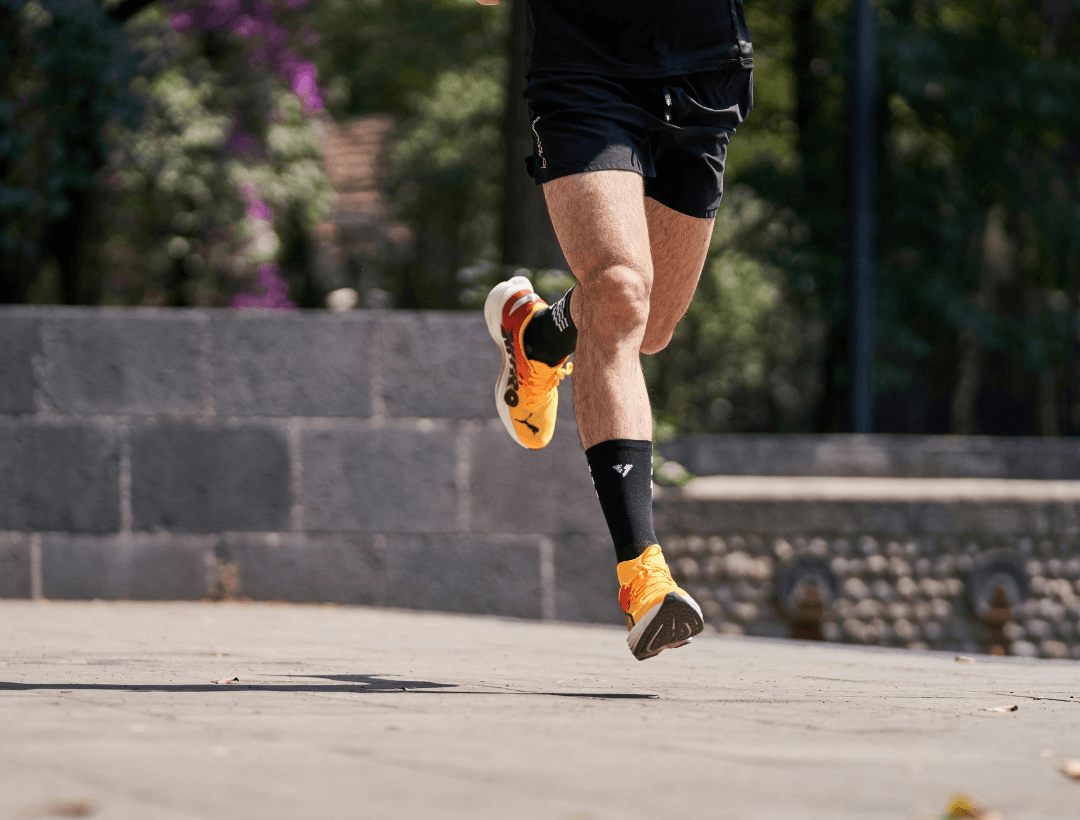
When you are travelling, the goal is not to make progress. The goal is to not lose ground. A 30-minute hotel gym session that hits your main movement patterns and keeps protein high is a win. That framing matters because most people judge travel weeks against their best week at home, which is the wrong benchmark entirely.
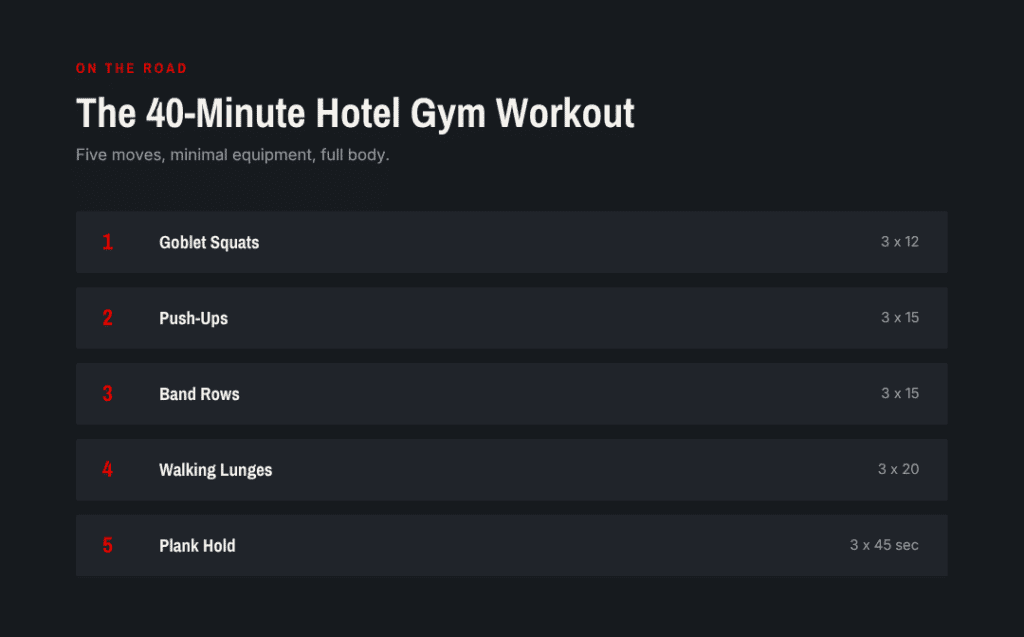
Most hotel gyms have dumbbells, a cable machine, a bench, and cardio equipment. That is enough. Dumbbell Romanian deadlifts, dumbbell rows, push-ups, goblet squats, and a plank variation cover every major movement pattern in 40 minutes. Research in the Journal of Human Kinetics confirms that dumbbell and bodyweight training at sufficient intensity maintains strength and muscle mass during short deload periods. The keyword is intensity; going through the motions does not count.
The sessions that happen during travel are the ones blocked on the calendar before the trip starts. The ones left to chance get skipped, not because of laziness but because the schedule fills up. Twenty to thirty minutes in the morning before the day starts is the most reliable window. Decide in advance, and the day cannot take it away.
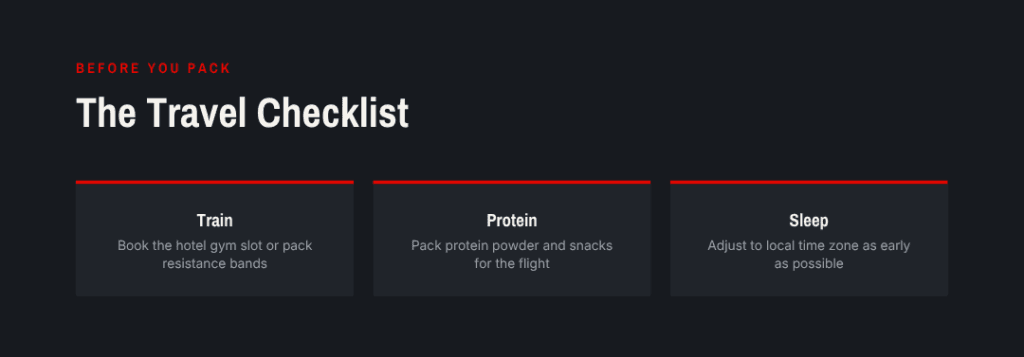
You do not need to eat perfectly on the road. You need a default that maintains high protein. That means knowing what you are going to order before you sit down at the restaurant, not figuring it out after three drinks at the work dinner.
Hotel breakfast options almost always include eggs. Restaurants always have a protein option. The challenge is not availability; it is priority. Protein bars, Greek yogurt, cottage cheese, and deli meat are available at most airports and grocery stores. None of this requires meal prep. It requires knowing what you are looking for.
Protecting the sleep window matters more than fitting in an extra session. If you have a 6 a.m. flight, skip the workout. Getting five hours of sleep to fit in a training session does more damage than missing the session entirely.
Alcohol is the most common travel sleep disruptor, and most people underestimate it significantly. The Sleep Foundation’s research on alcohol and sleep confirms that even moderate intake suppresses REM sleep and increases sleep fragmentation, which directly affects body composition and training performance the next day. One or two drinks feel harmless. The sleep data tells a different story.

One reason online coaching works well for people who travel frequently is that the travel version of the program is built in from day one. Hotel gym alternatives, bodyweight options, a nutrition default for road weeks- it is one continuous system rather than a gap in the program every time someone boards a flight. That continuity is what keeps progress moving instead of resetting repeatedly. For anyone curious about how online personal training actually works, that is the core of it.
Key Takeaways
The key is having a travel-specific system rather than trying to replicate your home routine. A 30- to 40-minute hotel gym or bodyweight session covering the major movement patterns, combined with high-protein eating and protected sleep, maintains fitness during travel weeks.
Dumbbell Romanian deadlifts, dumbbell rows, push-ups, goblet squats, and a plank variation cover every major movement pattern with standard hotel gym equipment. Forty minutes at sufficient intensity is enough to maintain strength and muscle during travel.
Prioritize protein at every meal. A moderate, sustainable default rather than perfection is the standard. Keeping protein high while managing alcohol is the highest-leverage nutrition habit during travel.
Occasional travel does not ruin progress. Repeated travel weeks without a system does. A consistent travel protocol that maintains training and nutrition prevents the cumulative setbacks that derail long-term progress.
Skipping entirely is worse than a modified session. But if sleep is severely compromised, skipping the session is the right call — sleep deprivation combined with training does more harm than skipping.
Rob Moal
Rob Moal is an online personal trainer with over 20 years of experience training busy professionals, executives, and athletes. He holds credentials in FMS, CAFS (Grey Institute), and Precision Nutrition, and has been featured in GQ, Forbes, Men’s Journal, Parade, and Eat This Not That.
Book a Free Intro CallReferences