
By Rob Moal, Online Personal Trainer | FMS, CAFS, Precision Nutrition | Published: 2026
GQ asked me how to build muscle as fast as humanly possible for their August 2026 piece, 10 Ways to Build Muscle as Fast as Humanly Possible. My answer wasn’t exciting. The principles haven’t changed in decades. Old school lifting, Eastern European methods and German volume training all run on the same basics. They just keep getting repackaged.
Here’s the longer version, the way I explain it to clients.
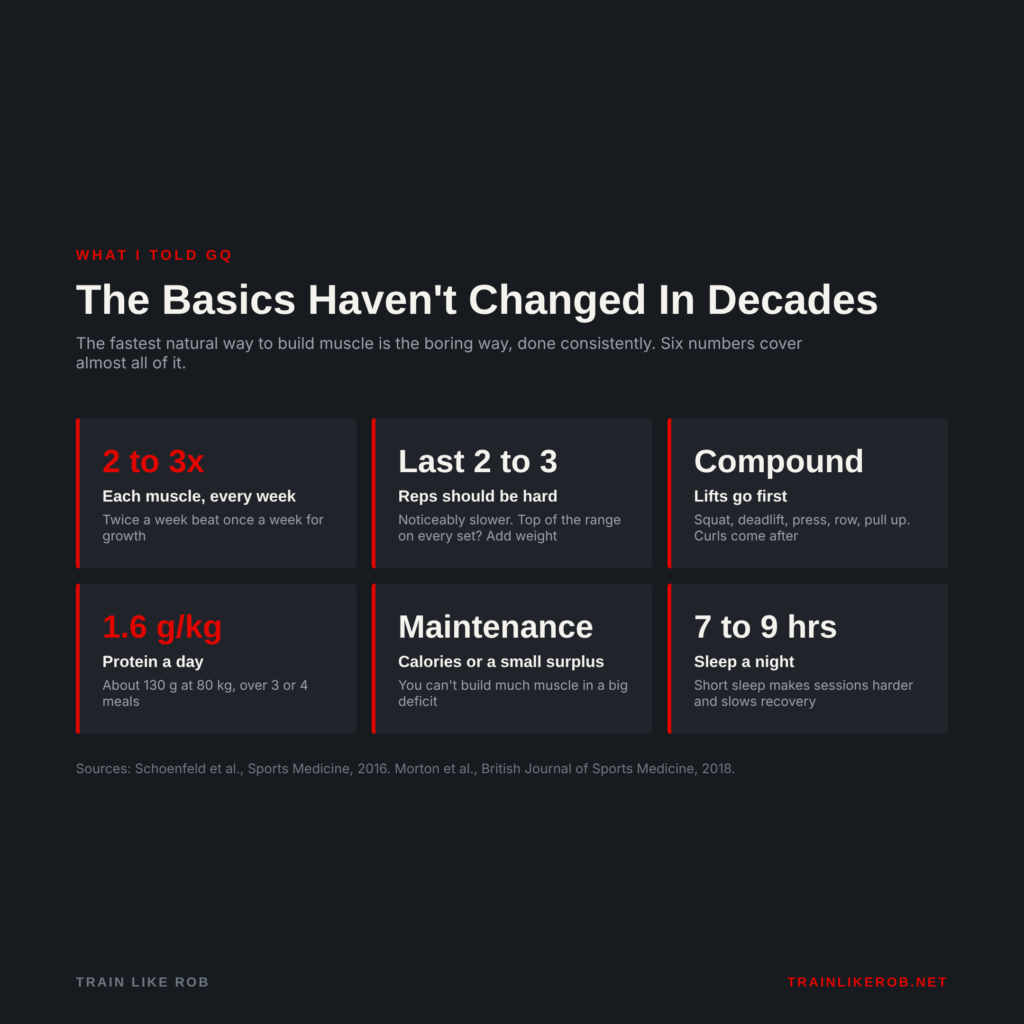
Muscle grows when you ask it to do slightly more than last time. Use a weight that makes the last two or three reps of each set hard and noticeably slower. When you hit the top of your rep range on every set, add a small amount of weight.
If you’re not tracking your lifts, you’re guessing. Write down the weight and reps for every exercise.
A 2016 meta-analysis in Sports Medicine found training a muscle at least twice a week produced more growth than training it once. For busy people, that usually means two or three full-body sessions a week, not a bodybuilder split with a chest day and an arm day.
Squats, deadlifts, presses, rows and pull-ups work several muscles at once and let you move the most load. Put them first in the session, when you’re fresh. Isolation work like curls and lateral raises goes after.
Implement choice matters too. Dumbbells, barbells, cables and machines all build muscle. Pick the version you can load safely and progress for months.
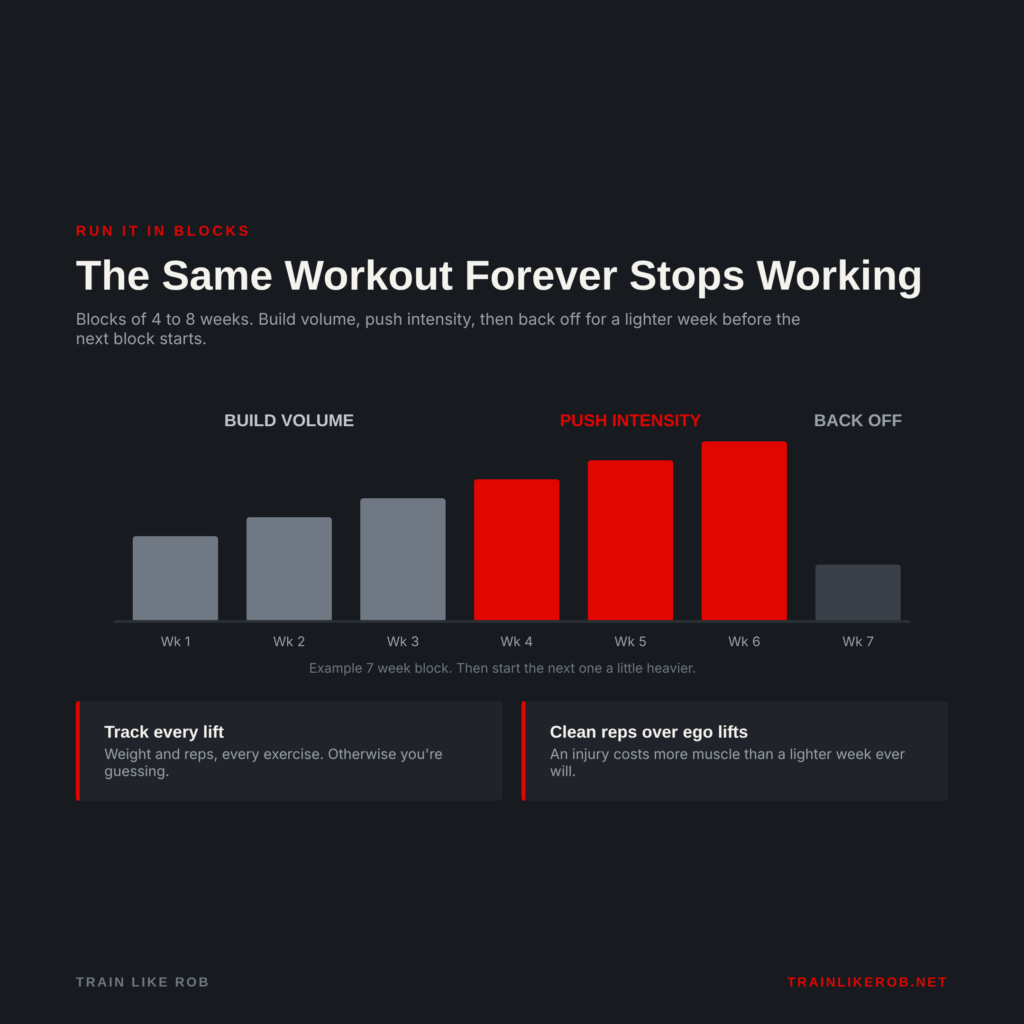
Doing the same workout forever stops working. I run clients in blocks of four to eight weeks: build volume, push intensity, then back off for a lighter week before the next block. That rhythm keeps you progressing without grinding yourself down.
A meta-analysis of 49 trials in the British Journal of Sports Medicine found protein supplementation improved muscle gains during resistance training, with little extra benefit above about 1.6 grams per kilogram per day. For an 80 kg person, that’s roughly 130 grams a day, spread over three or four meals. I break down the numbers in how much protein you actually need, and the protein calculator gives you your number.
You can’t build much muscle in a big calorie deficit. If muscle is the priority, eat at maintenance or a small surplus.
Sleep is where hormone production peaks, so it needs protecting like any other training variable. Aim for seven to nine hours. Short sleep makes sessions feel harder and slows recovery.
Controlled reps beat sloppy heavy ones. If your form breaks, lower the weight. An injury costs you more muscle than a lighter week ever will.
Most people see visible change over months, not weeks. Take photos and measurements once a month. Weekly checks will drive you crazy.

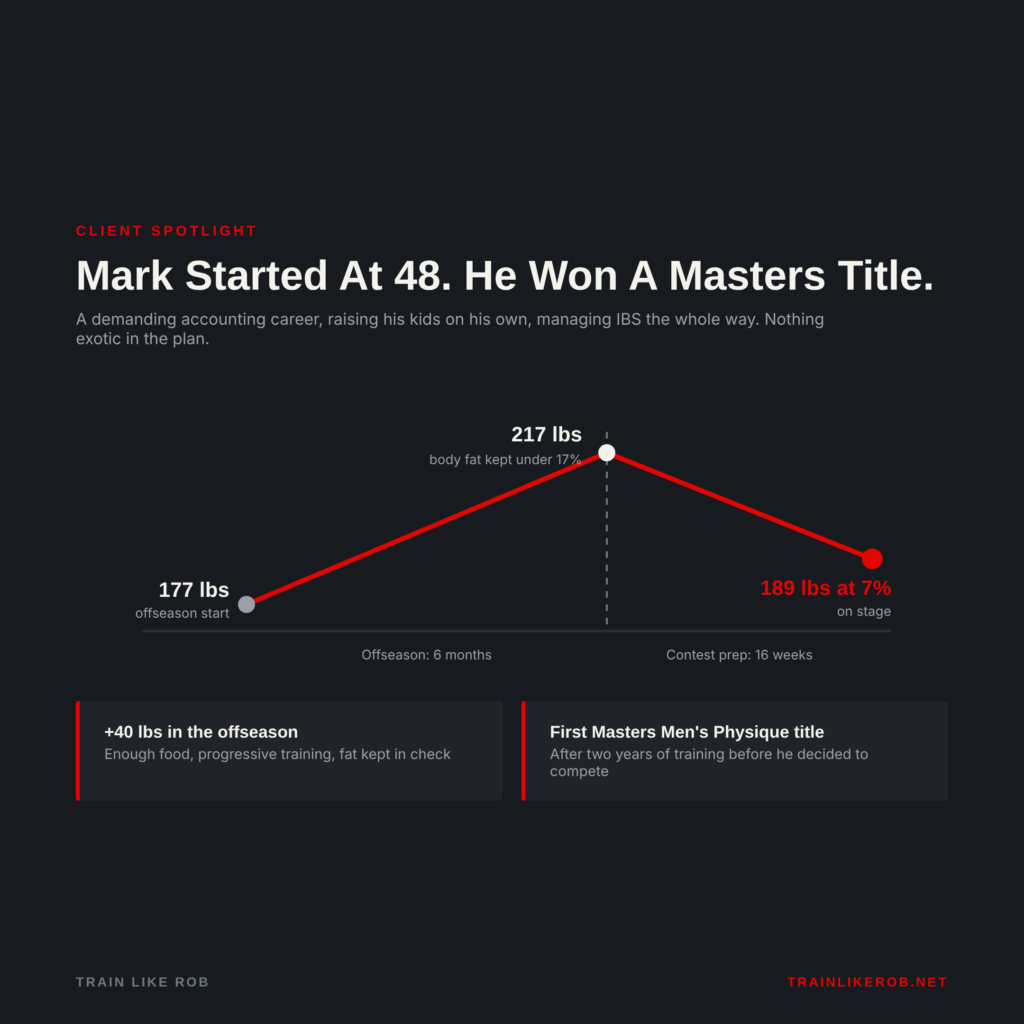
Mark started training with me at 48. He had a demanding accounting career and was raising his kids on his own. Two years in, he decided he wanted to compete in Men’s Physique.
He did it while managing IBS the whole way, which made hitting his protein harder. Nothing in his plan was exotic. It was progression, enough food and recovery, done consistently for years.
If you’ve been lifting for six months and your numbers aren’t moving, the problem is usually the program, not your genetics. That’s where personal training or online coaching helps: someone checking your form, adjusting your blocks and setting your food targets.
Beginners can gain noticeably in the first few months, then progress slows. Expect your strength to climb faster than your size at first.
No. Food comes first. Protein powder is a convenient way to hit your target, and creatine monohydrate is the one other supplement with strong research behind it.
Yes. You may need more recovery between hard sessions, but the same principles work. Mark started at 48.
Both work if the sets are taken close to failure. Heavier weights build more strength. Moderate weights for 8 to 15 reps are easier on the joints for most people.
You might also find these helpful:
GQ. “10 Ways to Build Muscle as Fast as Humanly Possible.”
British Journal of Sports Medicine. “A systematic review, meta-analysis and meta-regression of the effect of protein supplementation on resistance training-induced gains in muscle mass and strength in healthy adults.”
Sports Medicine. “Effects of Resistance Training Frequency on Measures of Muscle Hypertrophy: A Systematic Review and Meta-Analysis.”