
By Rob Moal, Online Personal Trainer | FMS, CAFS, Precision Nutrition | Published: 2026
Everyone wants to lose fat. Almost nobody wants to lose muscle doing it. Most popular approaches don’t even try to separate the two, and the research shows exactly why that’s a mistake.

The number moves depending on the study and how much weight is coming off, but the range is well established. In healthy adults without obesity, research tracking body composition during calorie restriction found that, on average, 14% to 23% of total weight lost is lean mass. Push past 10% of your starting body weight, and both lean mass and bone density take a bigger hit.
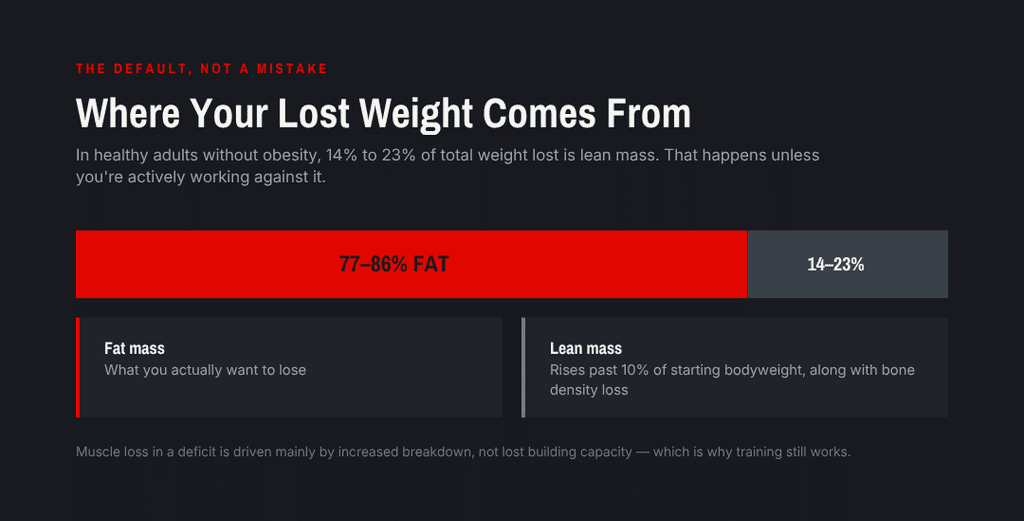
That’s not a sign something’s wrong with your plan. That’s the default. It’s what happens unless you’re actively working against it.
It’s not as simple as “your body burns muscle for fuel,” even though that’s how it usually gets explained. Research on short-term aggressive calorie restriction found that muscle loss is driven mainly by your body breaking more muscle down, not by it losing the ability to build muscle in the first place. Interestingly, moderate calorie restriction with meaningful weight loss can actually increase muscle protein synthesis; breakdown just outpaces it anyway.
That distinction matters. Your body isn’t shutting off muscle-building capacity during a diet; it’s tipping the balance the wrong way. Training is how you tip it back.
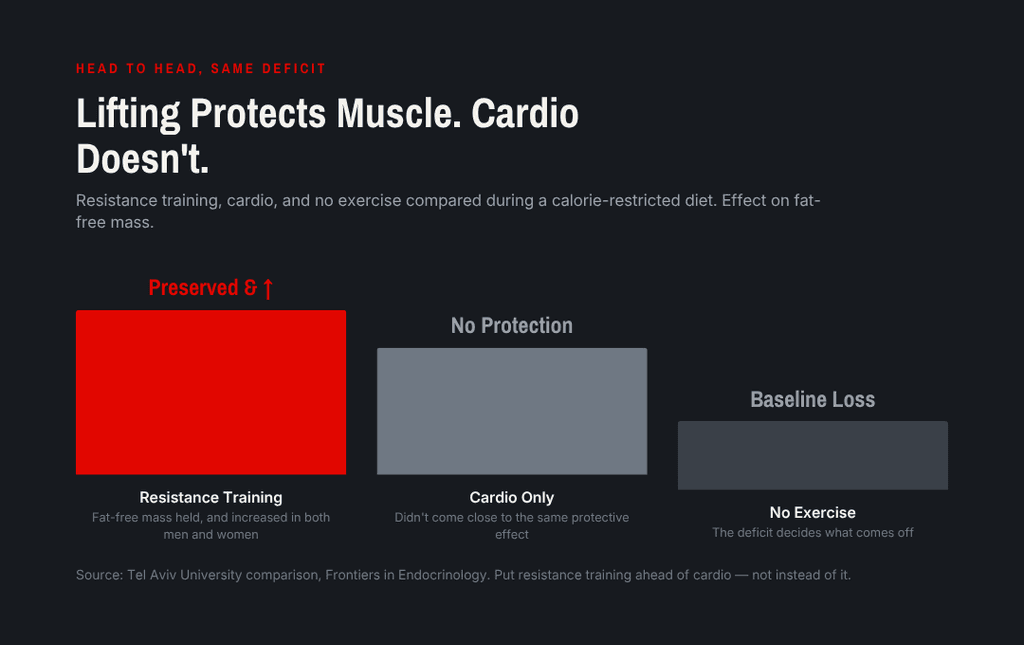
A study out of Tel Aviv University put resistance training, cardio, and no exercise head-to-head during a calorie-restricted diet. Resistance training preserved and even increased fat-free mass in both men and women. Cardio didn’t come close.
A separate meta-analysis backs this up with a specific number: anyone training to preserve lean mass during weight loss should keep their deficit under about 500 calories a day. That’s a real, actionable ceiling, and it directly kills the idea that a bigger deficit just means faster results with no cost.

Mariah came to me at 26 wanting fast, real change. Not a slow burn, an aggressive result. Fine, but aggressive fat loss only works without wrecking your body if the plan underneath it is airtight.
We built her around 4 days a week of structured weight training paired with dedicated conditioning, giving her body a reason to hold onto muscle while the fat came off instead of just shrinking everything indiscriminately. The nutrition side had to match that intensity exactly, a plan she could actually run every single day, not something that folded the first stressful week. No crash dieting. In 12 weeks, she lost 35 lbs. That number isn’t a shortcut. It’s what happens when someone shows up for every session and every meal without wavering.
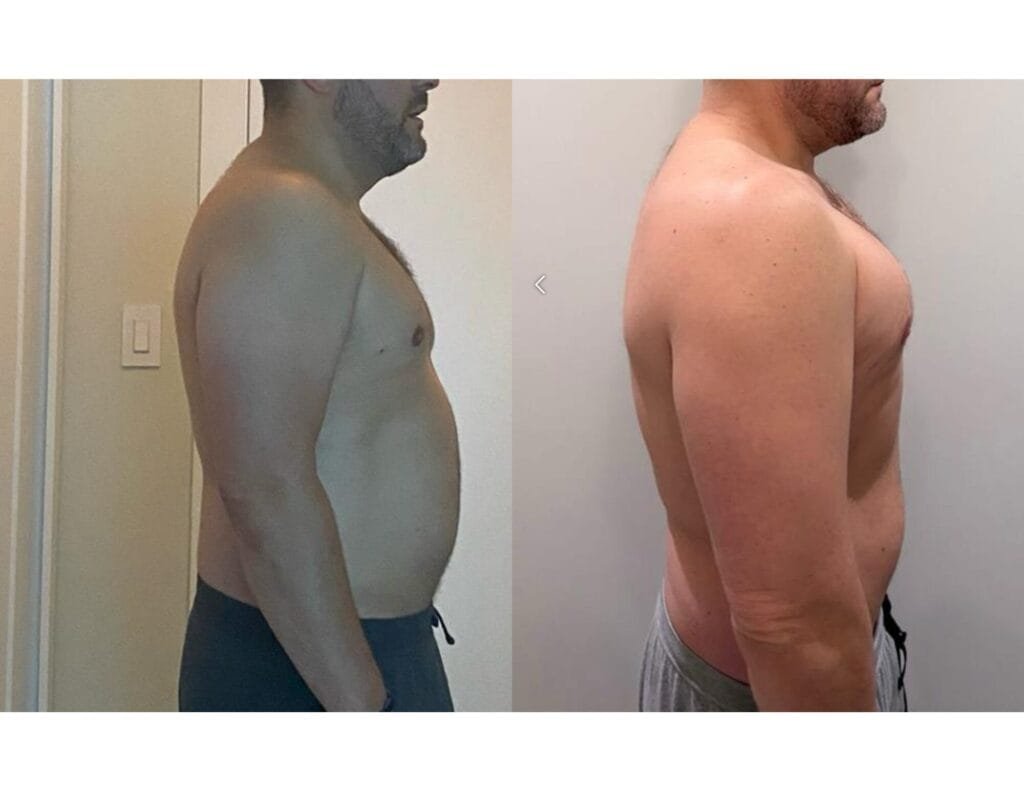
Cam was the opposite setup. 51 years old, a demanding career, a family of four, and a knee injury limiting what he could do. He didn’t have room for anything complicated, and he didn’t need an aggressive deficit to see change.
Two training sessions a week, built around what his knee could actually handle. In 8 weeks, he dropped 2 inches off his waist, lost 2% body fat, and dropped 8 lbs, all without adding a single ounce of stress to a schedule that was already full. That’s the moderate-deficit case study. Slower, sustainable, and it worked without asking him to reorganize his entire life around it.
This is probably the most underrated lever in fat loss content. A moderate deficit paired with training and real protein intake preserves lean mass noticeably better than an aggressive one, even when the aggressive deficit moves the scale faster. The tradeoff isn’t speed. It’s what kind of weight you’re actually losing.
Go too aggressive, and it gets worse fast. Research on severe short-term restriction, 30 to 40% below maintenance, found meaningful fat-free mass losses even with exercise in the mix. One detail worth remembering: the trained limbs in that study lost proportionally less muscle than the untrained ones. Train the tissue, even under brutal restriction, and it gets some protection. Don’t train it, and it doesn’t.
Data from the CALERIE 2 trial, a two-year calorie restriction study in healthy adults, found that while people lost lean mass and absolute strength over time, relative strength, strength for your body size, held steady or even improved. You can lose some muscle and still get functionally stronger for your size, as long as you’re training through it instead of just riding the deficit out.
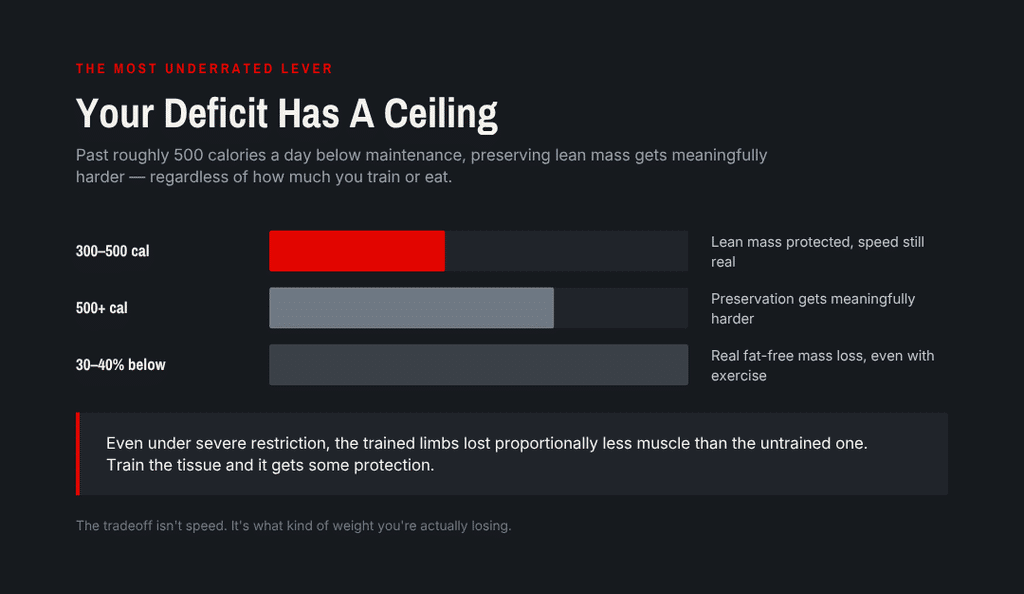
Keep the deficit moderate. 300 to 500 calories below maintenance is where lean mass gets protected without giving up so much speed that you quit halfway through.
Put resistance training ahead of cardio, not instead of it. The data isn’t close on this one.
Get protein right. That’s the other half of the equation, and it deserves its own explanation, which I cover in how much protein you actually need. Want your specific number? My protein calculator gets you there fast.
If you want the exact numbers for your deficit and training instead of guessing, the fat loss calculator is the quickest way to get a real starting point. And if you’re working through it on your own right now, my free fat loss guide walks through the whole approach.
Largely yes. Research shows the typical range is 14% to 23% of total weight lost, though resistance training and adequate protein significantly reduce how much you lose.
Yes, generally. Research suggests deficits larger than about 500 calories a day make preserving lean mass meaningfully harder, regardless of training.
Resistance training. Studies directly comparing the two found resistance training preserved and even increased fat-free mass, while aerobic exercise didn’t produce the same protective effect.
Relative strength, meaning strength for your body size, can hold steady or even improve during fat loss, even if some absolute muscle mass is lost, provided you’re training through the deficit.
You might also find these helpful:
Frontiers in Endocrinology. “Resistance training as a key strategy for high-quality weight loss in men and women.”
ScienceDirect / Advances in Nutrition. “Preserving Healthy Muscle during Weight Loss.”
Frontiers in Nutrition. “Comparing exercise modalities during caloric restriction: a systematic review and network meta-analysis on body composition.”