
Author: Rob Moal, CPT | Published: 2026 | Reviewed by: Rob Moal, CPT, FMS, Precision Nutrition
Quick Answer
Strength training is more effective than cardio for sustainable fat loss because it preserves muscle mass during a calorie deficit, which protects your resting metabolic rate. Cardio burns calories in the short term but doesn’t send the preservation signal your body needs to hold onto lean tissue. For busy professionals over 35, resistance training is the foundation — 3 to 4 sessions per week with progressive overload beats any cardio-based approach for long-term results.
If you want to lose weight and keep it off, strength training must be the foundation of your program. Cardio can help create a calorie deficit, but it does not preserve muscle, protect metabolism, or maintain structural integrity the way resistance training does. That difference is what determines whether fat loss is temporary or sustainable.
In cities like Vancouver, where people are generally active, the mistake isn’t inactivity. It’s a strategy. Many professionals run, cycle, hike, and attend high-intensity classes consistently yet still struggle to maintain long-term weight loss. The issue is not effort. It’s the lack of structured resistance training.
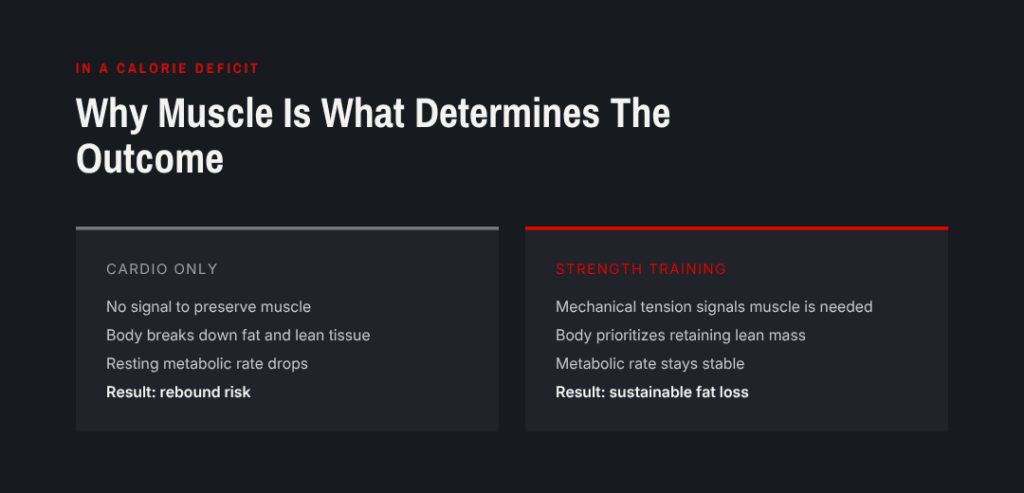
The human body does not simply “burn fat” when calories are reduced. When you enter a calorie deficit, the body reduces total tissue mass. Without a signal to preserve muscle, it will break down both fat and lean tissue. This is where most weight-loss programs quietly fail. When lean mass declines, resting metabolic rate drops. That means you burn fewer calories doing nothing. Over time, this makes maintenance harder and increases the likelihood of rebound weight gain.
When you load the body by progressively squatting, pressing, hinging, and pulling, you create mechanical tension that signals to the body that muscle tissue is necessary. Even in a calorie deficit, the body will prioritize retaining lean mass if that signal is strong enough. That preservation stabilizes metabolic rate and maintains structural strength.
Cardio does not provide the same signal. It improves cardiovascular efficiency, which is valuable, but it does not meaningfully protect muscle mass during dieting unless paired with resistance work. In fact, excessive cardio while under-eating can accelerate fatigue and muscle loss.
The body is efficient by design. The more repetitive endurance work you perform, the more efficient you become at it. Over time, your body learns to perform the same work while expending fewer calories. This is beneficial for survival, but not ideal for someone trying to lose fat. To maintain the same calorie burn, you must increase duration or intensity, which increases fatigue and often increases hunger.
Strength training operates differently. Rather than becoming more efficient in ways that reduce energy expenditure, it builds capacity. You increase load, improve neuromuscular coordination, and recruit more muscle fibres. Your output increases. Performance improves. The goal is progression, not repetition.
This distinction becomes even more important. Muscle mass naturally declines with age if not trained. This decline affects posture, joint stability, insulin sensitivity, and overall metabolic resilience. If fat loss is attempted without resistance training during this stage of life, the result is often a smaller but weaker body, one that feels less capable, not more.
There is also a hormonal component that is often overlooked. Chronic stress is common among high-performing professionals. When stress is elevated, cortisol remains elevated. Excessive cardio layered on top of work stress compounds fatigue. Properly programmed resistance training, however, can improve stress tolerance by strengthening the neuromuscular system without excessively draining it. The difference lies in dosage and structure.
This is not an argument against cardio. Cardiovascular health matters. Moderate-intensity aerobic work supports heart health, recovery, and general movement capacity. The mistake is allowing cardio to replace strength rather than support it.
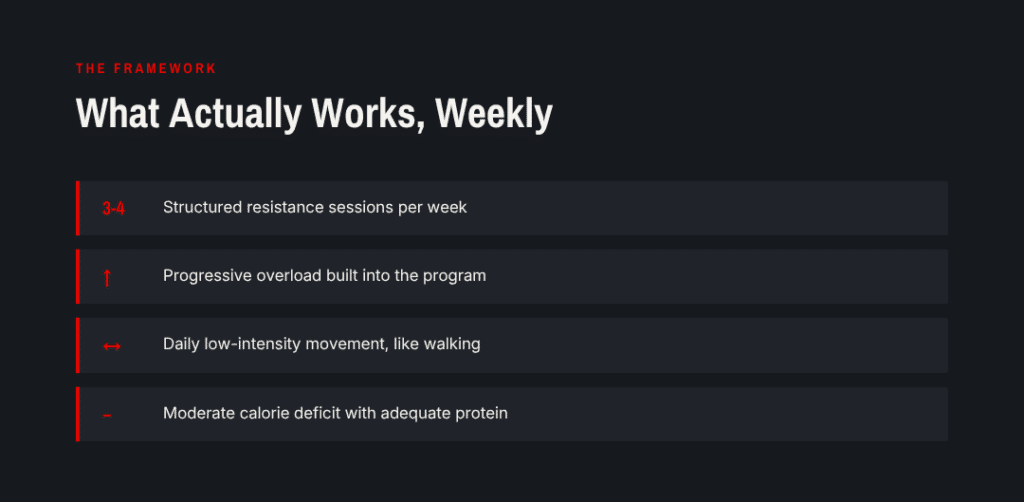
Three to four structured resistance sessions per week, progressive overload built into the program, daily low-intensity movement such as walking, and a moderate calorie deficit supported by adequate protein intake. This approach protects muscle, supports metabolism, and reduces the risk of plateaus.
Scale weight alone is a crude metric. Two individuals can weigh the same but look and function entirely differently, depending on muscle mass and fat distribution. Strength training shifts body composition in a favourable direction, even if total body weight changes slowly. This is why people who lift often look leaner at the same weight compared to when they relied on cardio alone.
Long-term sustainability is the real measure of success. The goal should not be to lose weight quickly, but to maintain a leaner, stronger physique years from now. Strength training builds the structural and metabolic base that makes maintenance possible. Without it, the body adapts to lower muscle mass, a lower metabolic rate, and a higher risk of regain.
In practical terms, if someone in Vancouver is already active, walking frequently, skiing in winter, hiking in summer, adding structured resistance training is the missing variable. It improves joint resilience for those outdoor activities, reduces injury risk, and enhances performance. Cardio makes you tired. Strength training makes you capable.
Sustainable fat loss is not about burning the maximum number of calories in a single session. It is about preserving muscle, maintaining metabolic rate, and building a body that manages energy efficiently over time. Strength training accomplishes that in a way cardio alone cannot.
The question should not be, “How much can I burn today?”
It should be, “How do I build a body that performs well for decades?”
That answer begins with resistance training.
Key Takeaways
Strength training is more effective for sustainable fat loss. Cardio creates a calorie deficit in the short term, but without resistance training, your body breaks down muscle alongside fat. That muscle loss lowers your resting metabolic rate, making fat gain more likely over time.
Yes. A structured resistance training program combined with a moderate calorie deficit and adequate protein intake is enough to drive significant fat loss. Low-intensity movement like daily walking is a useful addition, but dedicated cardio sessions are not required.
Three to four sessions per week is the effective range for most people. Consistency and progressive overload matter more than frequency. More is not always better, particularly for busy professionals managing work stress alongside training.
If your training is primarily cardio-based, your body has likely adapted to that workload and is burning fewer calories than it once did. Without resistance training, you may also be losing muscle alongside fat, which lowers metabolic rate and makes further progress harder. The missing variable is usually structured strength work.
The principles are the same, but the stakes are higher. Muscle mass declines naturally with age, which affects metabolism, joint health, and hormonal balance. For professionals over 35, resistance training is not optional — it is the primary tool for maintaining body composition and long-term physical function.
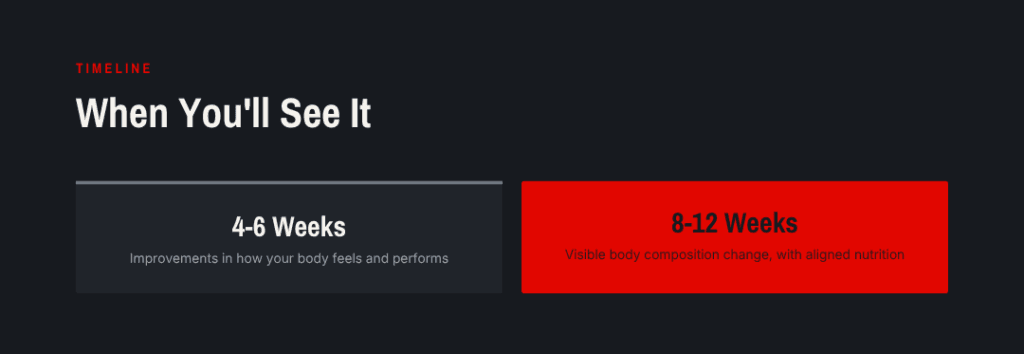
Most people notice improvements in how their body feels and performs within four to six weeks. Visible changes in body composition typically follow at eight to twelve weeks, provided nutrition is aligned with the goal.
You can make progress on your own, but a trainer eliminates the guesswork, ensures programming is progressive, and keeps technique sound. For busy professionals in Vancouver, that structure is often the difference between inconsistent effort and real, lasting results.
About the Author
Rob Moal is a Vancouver-based personal trainer with 20+ years of experience. FMS, CAFS (Grey Institute), Precision Nutrition, CanFitPro certified. Trains busy professionals at Evolve Strength in downtown Vancouver. Featured in GQ, Men’s Journal, Forbes, and Eat This Not That. Book a consultation here.